

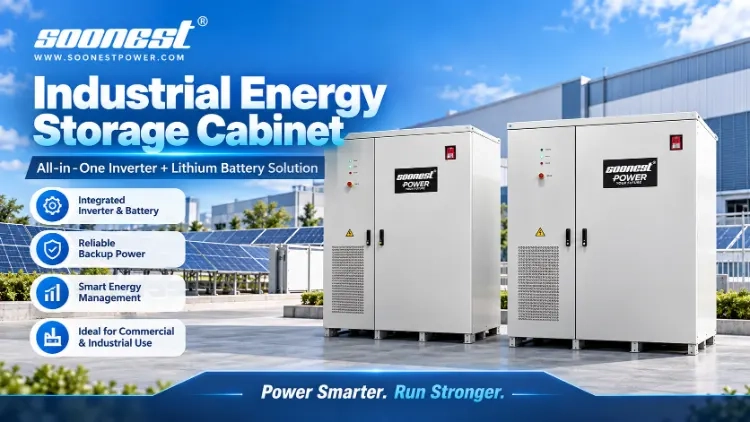
Ask a factory owner in Lagos what really eats his margin and he won’t say labor. He’ll say diesel. Grid goes down. On comes the genset. Month end, the fuel receipt dwarfs everything else on his desk. One plant operator we spoke to put diesel spend above payroll. He wasn’t exaggerating.
Another option exists, and it is simpler than most people expect. Put a 100kW/215kWh commercial energy storage cabinet next to the plant. It quietly charges on cheap night power. If the grid stumbles, if the tariff climbs, the stored power simply flows back into your machines. And you hear no genset outside the office window, you smell no exhaust over the yard, and nobody wastes a morning hauling jerricans across town.
In the next few sections I want to cover three things: how these cabinets work in practice, what the enclosure actually contains, and the checks I would run before spending money on one.
Why Diesel Alone Stopped Working
Three pressures hit businesses at once.
Fuel first. Diesel pricing follows the currency market, the freight market, and whatever the subsidy regulator decided last quarter. It does not stay cheap.
Grid second. Outages on these grids are not really surprises; most arrive on a timetable. Voltage sags in the evening. And one breaker tripping at the wrong moment can stall a motor line and write off whatever was mid-batch.
Demand third. You bought machines, added a cold room, fitted air conditioning. That genset specified back in 2015 is hauling double the load it was built for.
Storage handles all three. Fill the cabinet when power is cheap, or free off the roof. Drain it when tariffs bite or the grid quits. The handover takes milliseconds. Your production line won’t even blink.
What Is Actually Inside the Cabinet
People assume storage is just a big battery. It isn’t. A proper commercial and industrial (C&I) cabinet is seven systems working together.
1. Battery system. LiFePO4 cells stack into modules, and modules stack into packs; the pack is what most cabinets actually work with. Above every cell sits a built-in battery management system (BMS) that checks its voltage and current and temperature, trims any drift back into line, and will cut the whole string offline if one reading looks wrong. How long your system lives comes down to cell grade plus how precisely that BMS does its job.
2. PCS, the power conversion system. Batteries hold DC. Machines want AC. The PCS bridges the two. It charges from grid or solar, then feeds the plant at discharge time. Watch its efficiency figure. A lost point there is lost money, every day the plant runs.
3. EMS, the energy management system. The brain of the outfit. Your tariff schedule, your plant load, whatever the roof happens to be producing, how full the batteries sit, all of it feeds the EMS, and the EMS alone decides when to charge and when to let go. During peak hours the cabinet carries the plant. When demand spikes, the cabinet flattens the curve. Get a good EMS and the system pays for itself; get a poor one and you own an expensive box of batteries.
4. Distribution and protection. Contactors. Busbars. Breakers. Surge arresters. Engineers care about this part most. Most field faults trace back to sloppy distribution design, not the cells.
5. Thermal management. Nothing ages cells faster than heat. Liquid cooling is what holds a pack inside its safe temperature window when cycles come one after another all afternoon. Air-cooled units manage light duty and that is about it. For a 100kW-class cabinet cycling every day, liquid cooling is the baseline, not an upgrade.
6. Fire suppression. Smoke and heat sensors throughout, plus aerosol or heptafluoropropane suppression inside the enclosure. The idea is to catch a problem while it is still small and put it out while it is still cheap.
7. Enclosure. Outdoor-rated steel, sealed up against rain and dust, with room left inside for airflow, cabling and a technician to actually reach the parts. From the outside it is a box. What it protects is the investment.
How the Cabinet Earns Its Money
Four income streams. Roughly in order of impact.
Peak-valley arbitrage. Fill up at night on cheap tariffs, run the plant on that power through the expensive daytime hours. Where the spread is wide, 15 to 30 percent off the annual electricity bill is a realistic outcome.
Demand charge control. One motor startup can push demand charges through the roof for an entire billing cycle. The cabinet soaks up those spikes instead.
Backup power. Outage hits, and critical loads keep running. Cold rooms stay cold. Welders keep their arc. Server rooms stay up. Nobody restarts anything, and nobody scrapes a half-finished production run.
Solar pairing. Add rooftop panels. Store the surplus. Self-consumption can jump from about 30 percent to above 80, with far less power exported and far less imported. A DC-first system design squeezes even more from every panel.
100kW/215kWh or 100kW/241kWh?
Both are common C&I formats. The power rating (100kW) sets how hard the cabinet can push at any moment. The energy rating (215kWh or 241kWh) sets how long it can keep pushing.
Rule of thumb. Match the kW to your peak shaving need. Then check how many backup hours the kWh figure buys at your critical load. A 241kWh unit adds roughly 12 percent more runtime. Outages run long where you are? The extra capacity pays for itself fast.
SOONEST 100kW/215kWh C&I Energy Storage Cabinet
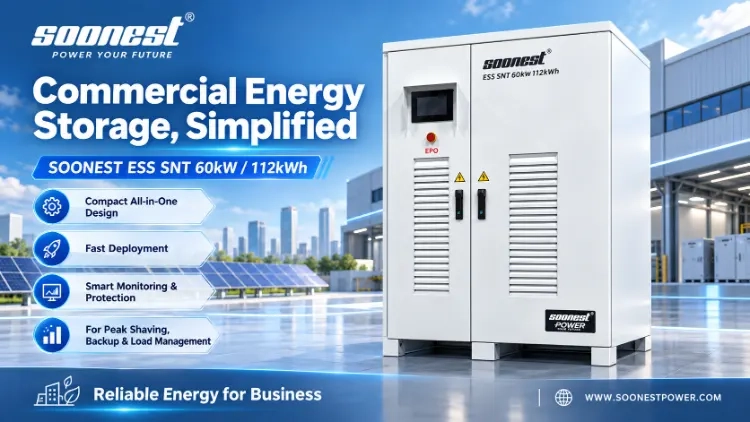
The SOONEST 100kW/215kWh commercial energy storage cabinet bundles all seven subsystems into one pre-commissioned outdoor unit. LiFePO4 cells. Liquid cooling. BMS, PCS, and EMS integrated. Fire suppression built in. Install it, connect it, and the EMS starts optimizing from day one.
Behind the product sits Zhejiang SOONEST New Energy Co., Ltd. Two decades in photovoltaics. CE, UL, ROHS, SONCAP, and ISO certifications across the range. OEM and ODM programs for distributors who want their own branding or modified specs.
Questions about sizing or local grid rules? The service and support team helps distributors and end users configure systems for their exact load profiles.
Five Checks Before You Buy Any Cabinet
Cell grade and cycle life. Ask for the datasheet. Six thousand cycles at 80 percent depth of discharge is a fair benchmark for LiFePO4.
Thermal design. Liquid cooling for daily-cycling duty. Ask how it performs at 45 degrees ambient. That’s a normal afternoon in many target markets.
Certification fit. CE and UL for general export. SONCAP if Nigeria is in the plan. Match the paperwork to the destination before shipping, not after.
EMS openness. Can it read your tariff schedule? Talk to your solar inverter? A closed brain limits the returns.
Service reach. Hardware fails eventually. Who answers the phone? How fast do spares move? Get warranty terms in writing.
Conclusion
Diesel kept your lights on for twenty years, and kept your costs a guessing game the whole time. A 100kW/215kWh cabinet turns that around. Hardware you pay for once. Running costs you can actually forecast. Protection that shows up exactly when the blackout or the tariff hike does.
Want numbers for your own site? Contact SOONEST for a load review and a tailored configuration quote.
FAQ
How long can a 100kW/215kWh cabinet back up my factory?
At a 100kW load, a bit over two hours. At a 50kW critical load, around four. Size the battery to the loads you actually must keep alive, not the whole plant.
Can it work with solar panels and diesel gensets together?
Yes. Hybrid setups are standard. The cabinet can charge from solar, the grid, or the genset, and the EMS picks the cheapest source at any moment.
What maintenance does it need?
Mostly inspections. Coolant levels. Connection torque. Filter condition. A look at BMS logs. Remote monitoring platforms flag most issues before anyone climbs a ladder.