

A split phase hybrid inverter quote should let you answer a fairly ordinary customer question: can this unit power the equipment on the load schedule? To answer it, look past the total kW. Get the permitted load on each 120V leg, battery discharge limits, and conditions attached to the AC rating before comparing prices. SOROTEC supplies solar inverter and energy-storage product families you can include in the enquiry. Send the load schedule and destination requirements with your RFQ. An 8kW or 12kW label helps you narrow the options, but you still need the operating limits to select one.

Key Takeaways
Provide each supplier with a copy of the proposed load pattern, including periods where only the battery will be used. This should help identify any offers that need to be amended. Key points to be included on the quote sheet and for use by both technical and purchasing teams.
- Total kW does not tell you the available power on one 120V leg.
- A battery’s energy capacity and discharge-power limit serve different purposes.
- PV voltage and current limits both matter when choosing modules.
- Approvals, accessories, firmware, and freight belong in the quoted scope.
The AC Rating Needs a Load Schedule
A split-phase output provides 120V from either line to neutral and 240V between the two lines. Your customer can therefore have both voltage classes in the load schedule. The buying question is how much of each the inverter can supply at the same time, especially when the grid is absent.
Total Output and One-Leg Duty
For a balanced 240V load at unity power factor, the calculation is 8,000W ÷ 240V = about 33.3A. Moving part of that demand to a 120V circuit changes the question. You now need the allowable output on that leg as well as the total inverter limit. The calculated 33.3A is not a model-specific current rating and cannot supply the missing per-leg figure.
At the top of your RFQ, clearly distinguish between 120V loads and 240V loads. List each 120V load by leg and indicate how often a 240V load is expected to overlap with the 120V loads. Supplier should indicate continuous output, per-leg limits, and amount of imbalance allowed for specified model. If supplier only lists total kW, then your question remains unanswered.
Rating supplied by grid must be clearly separated from battery only rating. As grid supplies power in normal operation, the electrical path will differ from the path for backup of loads in case of failure. Recording of mode and ambient of current ratings will save huge amount of time when apparently equivalent ratings are in fact for different modes of operation.
Starting Loads and Transfer Behavior
Continuous demand of a motor such as a pump or refrigeration compressor does not equal peak demand during start up. Gather information on the start up data and methods of the various pieces of equipment. Compare this information to the inverter’s surge rating and how long it can sustain it.
A word of caution: “surge” equals time. A short overload capacity is not equal to a longer starting duty even if the peak values look similar. Check the test evidence offered by a supplier for relevance to the actual purchase by checking load and operating conditions.
Transfer behavior of sensitive controls has to be checked as well and has to be compared with the documented transfer time of the equipment. A hybrid inverter is not a replacement for a UPS just because it can be powered from a battery as well.
Battery and PV Limits Can Change the Shortlist
The load schedule narrows your AC requirement. Now work back toward the energy sources. Battery restrictions can prevent an inverter from reaching its rated output, while a PV mismatch can rule out an otherwise attractive product. These checks belong before price negotiation.
The Battery Pairing You Are Actually Buying
“CAN supported” or “RS485 available” is not a complete compatibility answer. You need the battery model, protocol, firmware combination, and communication cable agreed for the order. Matching connectors are only part of the story.
While more battery kWh extends runtime, the pack itself has a power limit. In operation the BMS of the battery limits charge and/or discharge. Here continuous discharge current, temperature restrictions as well as behavior at low SoC have to be checked against the inverter rating.
This issue also needs to be clearly documented and described in detail as to how the loss of communication is handled, i.e. whether the system is switched off, voltage-based behavior is used or if another procedure is applied. Your service team needs to be able to clearly distinguish between the expected behavior in case of a fallback and a real failure. Also, it is your responsibility when selling a battery combination and not that of another reseller who then selects the batteries later.
Separate PV Current from PV Voltage
An MPPT tracker operates within a voltage window and a current limit. The maximum PV open-circuit voltage is another boundary; it should not be confused with the upper end of the tracking range. Obtain all three, plus the permitted short-circuit current.
The cold-weather voltage is determined from the proposed module’s data and the project design temperature. High current modules also require specific checks to the tracker inputs. Neither of these can be addressed by a general statement of ‘PV compatible’.
Even when you use Dual MPPT for different operating arrays, the constraints for each of the trackers are not removed. So when you compare suppliers for a combined input, make sure to state the values for each of the trackers separately. The combined value would tend to conceal the restrictions for the array you are planning to use.
A Product Candidate with Specific Buying Conditions
With the electrical requirement on paper, you can assess a real product family. Your aim is to choose a variant that fits, not to turn every feature in the brochure into a reason to purchase.
The REVO HMT IP54 L2P G2 Family
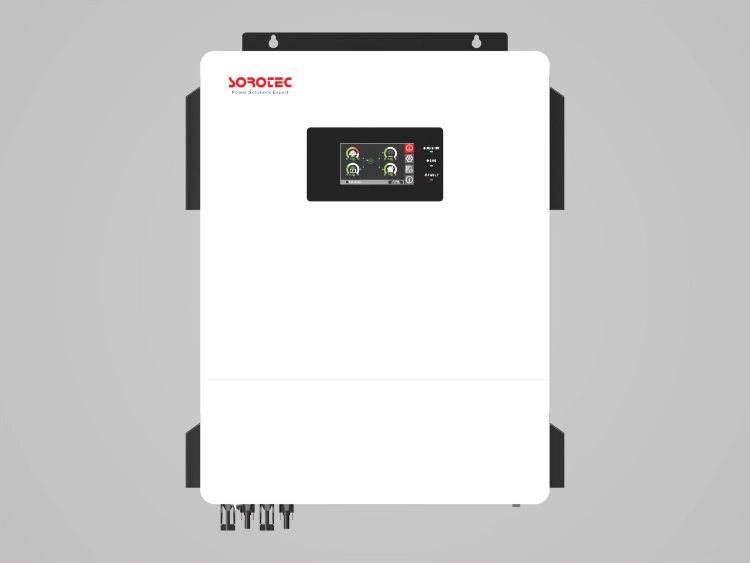
The REVO HMT IP54 L2P G2 split-phase hybrid energy-storage inverter is offered in 8kW, 10kW, and 12kW options. Its published features include 120/240V split-phase output, IP54 protection, dual MPPT trackers, and solar charging current up to 200A. For distributors and integrators serving those voltage and power requirements, it gives you a concrete family to evaluate. The quotation still needs the selected variant and its current technical documents.
| Published Feature | Point to Resolve in Your Enquiry |
| 8kW, 10kW, or 12kW | Continuous duty and per-leg output for the chosen variant |
| 120/240V split-phase output | Customer supply arrangement and load schedule |
| Dual MPPT trackers | Voltage, current, and short-circuit limits per tracker |
| Up to 200A solar charging current | Applicable variant and approved battery charge limit |
| IP54 enclosure | Environmental restrictions and temperature derating |
Use the official product details as the basis for that discussion. “Up to” describes a family maximum; your purchase needs the value applicable to the configuration being supplied.
Limits That Remain Relevant
IP54 as specified needs to be read in conjunction with the environmental restrictions detailed within the manual. The affects of direct sun on thermal conditions plus the affects of condensation and salt exposure need to be established. The label on the enclosure and a picture of it in an outdoor situation do not establish the permitted environmental conditions for the order as destined to be used. Details of the restrictions as applicable to the specified environment need to be established.
Split-phase power is not a “Yes” for your electrical network. Rather, solar panel system certificates will list specific models and the locations for which they were approved. Also, a family system is not intended to be a substitute for a higher-wattage three-phase C&I system, even though a business can purchase a small system and call it a “Commercial” system; however, the electrical capacity will remain the same.
What the Price Includes Matters to Your Margin
Once unsuitable options are removed, look at the delivered scope. The supplier’s company information helps with initial qualification. Your purchase agreement, however, has to name the equipment and obligations for this order.
A Quote Sheet You Can Compare
In many cases, FOB and delivered prices are not on the same boundary. Likewise, quotations to include monitoring accessories are not on the same boundary as quotations to exclude monitoring accessories. All of these should be costed on a common sheet to reveal the cost of each omission rather than the purchaser seeing it as a saving.
| Quote Item | Required Detail |
| Equipment | Model, variant, firmware, and included accessories |
| Battery support | Approved pairing and compatibility responsibility |
| Destination documents | Applicable model-specific certificates |
| Delivery | Incoterm, named place, packing, and confirmed lead time |
| Warranty | Coverage, exclusions, claim procedure, and freight responsibility |
| Service | Diagnostic contact and spare-parts arrangements |
A reseller’s interest in a warranty is to ensure that a long coverage period is of some use. That will only be the case if someone is able to explain the process for a replacement to be issued and who will pay for its transport. A reseller should therefore ensure that the necessary records are created whilst negotiating the order with the seller.
Relevant Application Evidence
The case-study collection gives you application context. For your shortlist, request evidence connected to the voltage, load duty, and operating mode you intend to sell. A photograph can show where equipment was used; it cannot establish surge capability or market approval.
A sample order may help you assess the agreed battery and monitoring combination. Define the acceptance checks first. Running a small steady load says little about the maximum duty in your customer’s enquiry.
Send an RFQ with the Open Questions Attached
Send the load schedule, battery details, PV module data, destination requirements, and order quantity through the sales contact page. For each proposed split phase hybrid inverter, request a price and a list of technical exceptions. Keep any open answer attached to the quotation until it is resolved.
The Purchase Approval
Confirm the model number on the supplier’s quote against the supplier’s technical note and the list of accessories as you ordered them. Note down the battery pairing and the service terms in the same order as they are listed in the file. Later variants or different firmware need to be reviewed against the relevant items even if the supplier describes them as equivalent. You want to purchase the model that you have assessed as suitable and for any changes to have been identified prior to shipment.
FAQ
Q:Can You Keep the Same Battery after Buying a Larger Inverter
A: Possibly. Check the battery’s discharge-power limit and approved compatibility with the larger model. Its kWh capacity alone cannot settle the question.
Q:Does a Higher Charge-Current Rating Mean Faster Charging
A: Only when the battery accepts that current and the energy source can supply it. Charging restrictions elsewhere in the system may become the limit.
Q:What Should a Replacement Unit Agreement Cover
A: Record the accepted model, firmware, accessories, and warranty treatment. A replacement from another family needs a fresh technical check before you accept it.