

Begin at the electrical panel. Write down the circuits that have to survive an outage, the motors that may start together, and the hours the battery is expected to last. Only then does an inverter rating mean much. At a 120/240 V North American site, the unit also has to carry both 120 V legs and any 240 V equipment without creating a lopsided backup panel. SOROTEC offers the REVO HMT IP54 L2P G2 in 8 kW, 10 kW, and 12 kW sizes. One of them may fit, but the choice comes from the site’s readings and start-up sequence rather than the brochure’s largest number.
Key Takeaways
- Separate power from runtime. The inverter covers simultaneous load and motor starting; the battery supplies energy over time.
- Check both sides of a split-phase panel. A site with a 240 V well pump is a different job from a backup panel containing only lights and receptacles.
- Match the battery and PV design to the exact model. Voltage windows, current limits, BMS communication, and string design can stop an otherwise sensible project at commissioning.
- Treat transfer time, IP rating, and surge power as bounded specifications. Ask how each value was tested and whether it applies to the regional model being quoted.
- Give every supplier the same load table and one-line diagram. Comparable inputs produce quotations that are easier to compare.
Start With the Loads, Not the Inverter
Walk the panel with the installer and mark the circuits that must remain live. A refrigerator, modem, security system, furnace blower, garage door, and a few receptacles may be enough for one customer. Another site may also need a 240 V pump, compressor, or mini-split. Those projects can have similar daily energy use and very different inverter requirements.
Check L1, L2, and the 240 V Loads
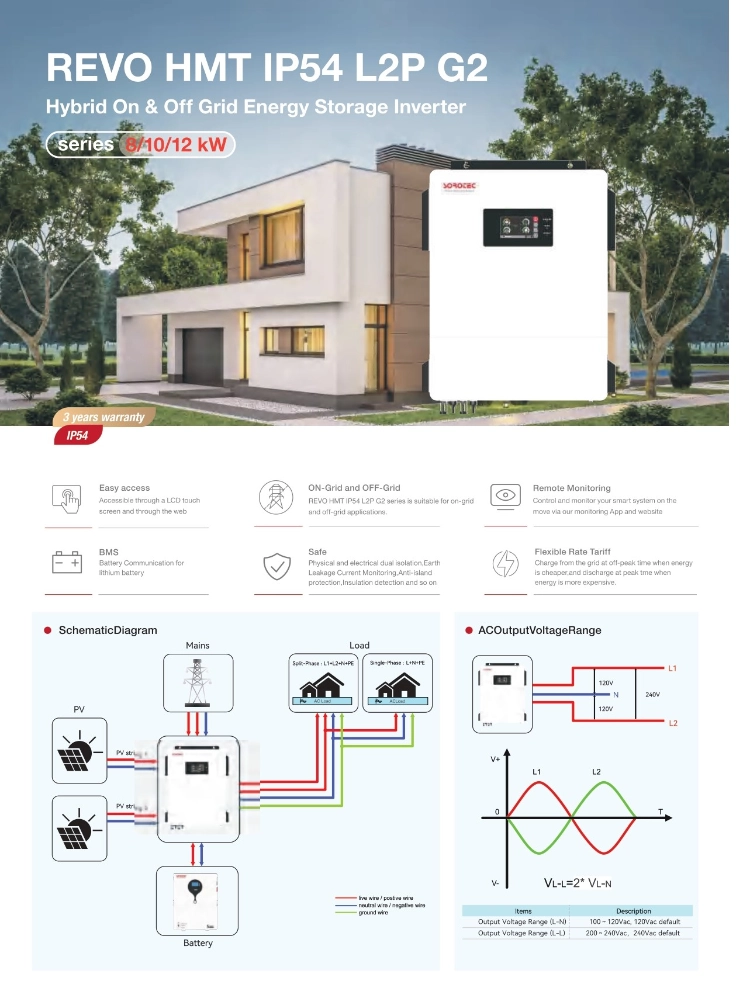
With native split-phase output, L1 and L2 each supply 120 V to neutral, while a load connected across the legs receives 240 V. The detail is easy to overlook on a load spreadsheet. Ten lightly used 120 V circuits crowded onto one leg can be a worse arrangement than a larger total load shared properly across the panel. Note the load on each leg and move circuits if the proposed backup panel is badly uneven.
Before the purchase order is released, the installer should sign off on service voltage, frequency, neutral and ground treatment, transfer equipment, and the local interconnection method. A panel made up only of 120 V circuits may not need this architecture. A 240 V pump or compressor usually makes a native split-phase unit the more straightforward option.
Size Power and Runtime Separately
For each protected circuit, note running watts, starting demand, voltage, duty cycle, and expected hours of use. Simply adding every nameplate produces an inflated total. A more useful test is a short timeline: the network gear and a few lights stay on, the refrigerator cycles, and the well pump starts while those loads are already present.
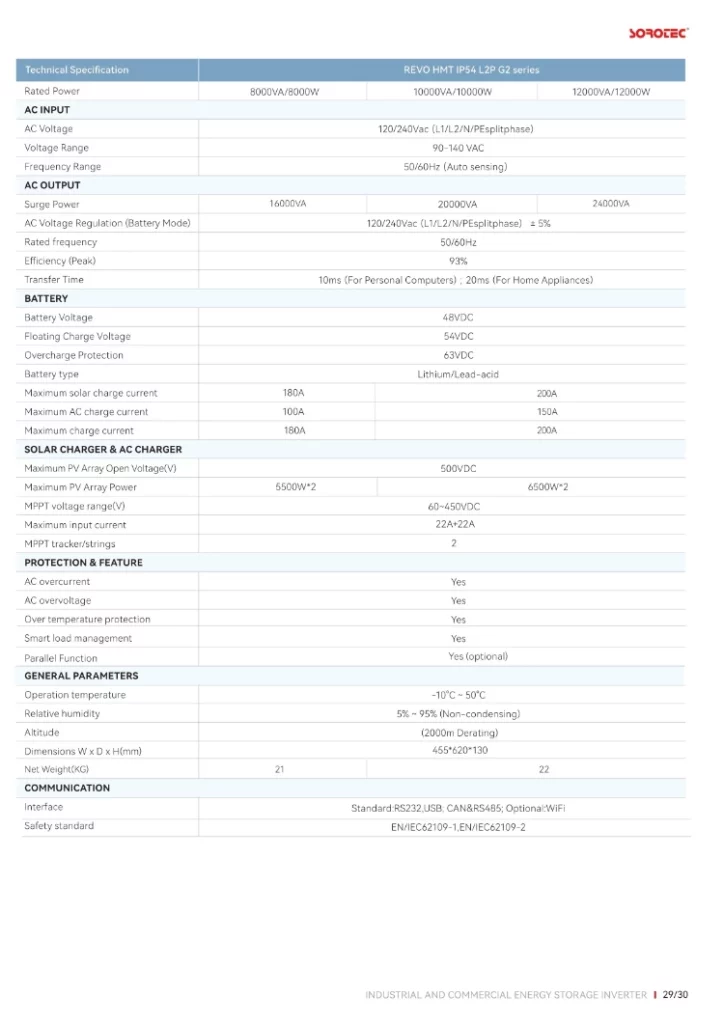
The three versions are rated at 8,000 W, 10,000 W, and 12,000 W. Their listed surge figures are 16,000 VA, 20,000 VA, and 24,000 VA. Read those pairs together. A motor does not care that the average house load is modest if its start pushes the inverter beyond the allowed surge time. Ask for that duration and compare it with the motor data. Sometimes a staged start or load-shed contactor is the cheaper fix; buying the next inverter size is not the only answer.
Battery runtime needs a separate calculation. Start with the planned kWh during the outage, then allow for reserve state of charge, inverter losses, temperature, cable loss, and the battery’s discharge-current limit. The quotation should identify the battery model, quantity, usable energy assumption, BMS protocol, and expansion method. A nominal battery capacity without those details is not a runtime promise.
Check the Complete Electrical Fit
The SOROTEC split-phase product page identifies the REVO HMT IP54 L2P G2 family and its 120/240 V output. Do not stop at the web page. Request the current regional datasheet and wiring diagram, because grid settings, firmware, and required accessories are not always identical from one market version to another.
Battery Voltage and Charging
This product family uses a 48 VDC battery bus and lists lithium and lead-acid options. Depending on the model, the solar charge limit is shown as 180 A or 200 A; AC charging is shown as 100 A or 150 A. Those large figures can be misleading when viewed alone. The battery bank, cables, breakers, temperature, and BMS may impose a lower working limit.
Put the battery pairing in the quotation. It should state the voltage window, CAN or RS485 profile, normal setting, peak charge current, cold-weather limits, and any approved-battery requirement. A mismatched BMS can look fine during a quick power-up and then throttle charging or fill the event log with alarms. Finding that out after delivery turns a product decision into a commissioning delay.
PV Strings and MPPT Limits
The specification shows two MPPT trackers, a 60-450 VDC MPPT range, and a 500 VDC maximum PV open-circuit voltage. It also lists two 22 A PV inputs and model-dependent array limits of 5,500 W x 2 or 6,500 W x 2. Verify the values against the exact unit being purchased.
Check the string at the coldest and hottest design temperatures. Cold modules can push open-circuit voltage above 500 V; hot modules can pull operating voltage below the tracker window. Either mistake comes from using a room-temperature calculation. The approved drawing should show module count, string layout, cable size, isolators, surge protection, grounding, and connector type.
Plan for Outages, Installation, and Service
Labels such as “on grid” and “off grid” say little about the moment customers actually notice: the changeover. Map four events on paper before installation – grid failure, a motor start during backup, the battery reaching reserve, and utility power returning. The expected response for each event belongs in the commissioning checklist.
Transfer Time and Sensitive Equipment
The product sheet lists 10 ms transfer for personal computers and 20 ms for home appliances. Those are model-specific values, not a guarantee that every load will ride through. Servers, medical equipment, communications hardware, and process controls may still need a tested online UPS or a separate critical-load path. Prove the arrangement with the actual equipment before removing an existing UPS.
Location and Maintenance Access
IP54 is useful in a garage or sheltered utility area; it is not a license to bolt the inverter to any exposed wall. The specification gives an operating range of -10 C to 50 C and 5% to 95% non-condensing humidity. The manual still controls clearance and derating. Direct rain, flood risk, corrosive vapor, or a dusty blocked airflow path remains a poor location.
Leave space to isolate the unit, inspect terminals, read the display, and service fans or communications hardware. Short battery cable runs help control voltage drop, yet service access still matters. Label L1, L2, neutral, ground, PV strings, battery conductors, and any generator connection. Record serial numbers, firmware, settings, measured charging current, and test results for later support.
The SOROTEC company profile dates the business to 2006. That history is less useful to a project team than a named support route. Ask who will review the one-line diagram, approve the battery pairing, and respond when an alarm or spare-parts question appears after delivery. The SOROTEC case-study library may suggest questions for a similar application, but it cannot replace a review of the new site’s loads and wiring.
Compare Quotes and Commission the System
Send the same RFQ package to each supplier. Include the 120/240 V service details, protected-load table, largest motor start, desired runtime, PV module data, battery preference, installation photos, and a one-line diagram. Then ask each bidder to state:
- rated and surge output, including surge duration;
- L1/L2 limits, neutral arrangement, frequency, and transfer behavior;
- battery model, usable energy, BMS protocol, and charge-current settings;
- MPPT range, maximum PV voltage, input-current limit, and approved string design;
- protection devices, alarms, monitoring interfaces, firmware policy, and required certifications;
- enclosure limits, clearances, warranty, spare parts, lead time, and Incoterms.
Commissioning is the point where the proposal meets the wiring. Run the system through PV charge, grid charge, battery discharge, grid loss, both 120 V legs, the largest 240 V load, reserve state of charge, and utility return. Write down L1-N, L2-N, L1-L2, frequency, battery current, transfer behavior, and any events. Then repeat a short transfer near the reserve setting. A full battery can conceal a current limit or a weak BMS link.
FAQ and Next Step
How do I choose between 8 kW, 10 kW, and 12 kW?
Start with the worst believable few seconds, not the monthly energy bill. If the pump starts while the refrigerator and base loads are already running, can the selected model carry that event for the required time? Pick the smallest version that passes that test and still leaves room for loads that are genuinely planned.
Can a split-phase hybrid inverter replace a UPS?
Not automatically. A hybrid inverter can transfer quickly, but the result depends on the load and the complete installation. Keep sensitive equipment on an online UPS until a site test confirms it tolerates the inverter’s transfer.
What should be confirmed before placing the order?
Before ordering, settle the regional model, current datasheet, 120/240 V wiring, surge duration, battery pairing, PV strings, protection, local compliance, warranty, and start-up support. Send the load table and one-line diagram to the SOROTEC contact team for a model-specific review and quotation. Check the SOROTEC website again when the order is prepared so outdated product information does not drift into the final specification.