

What are you trying to accommodate with the second MPPT input? If it’s an east-facing roof and a west-facing roof, there is a good reason to use it: you can put the two module groups on independent trackers. You haven’t yet answered the 8kW versus 12kW question, though. That depends on your loads and on the battery you’re pairing with the inverter. When comparing a dual MPPT split phase hybrid inverter, work from the proposed wiring and load list. The feature name on a quotation won’t tell you how many strings you can connect.
- Keep PV input current apart from battery charging current when reading the specification.
- Before choosing the cheaper quotation, check that both offers cover the same load and battery combination.
Compare the Two Trackers Before Comparing Total Kilowatts
As a module heats up or sunlight changes, its useful operating point moves. The MPPT controller adjusts voltage to follow it. With two independent controllers, the east-facing group can operate at one point while the west-facing group operates at another. Partial shade on one group is another reason to look at this arrangement. How much it helps depends on the modules and the shade pattern; two tracker inputs alone don’t establish an energy gain.
Independence Has Electrical Boundaries
The strings connected to one tracker have to share a voltage. Suppose the proposal puts strings with different exposure on that input. Their response will depend on string length, module characteristics and bypass-diode operation, so the loss cannot be read from roof direction alone. Moving a group to the other tracker can reduce the coupling. It won’t make an unsuitable series string electrically acceptable.
Ask to see the strings drawn out, with a module model and a tracker assignment for each group. You’ll want the start-up calculation as well as the checks for hot operation and cold open-circuit voltage. If the reply just says that two roof directions are supported, go back for the calculations.
Distinguish the Current Paths
Don’t let the ampere figures on the product page run together. Your loads are on the AC side.
Match the REVO HMT Family to the Exact Order
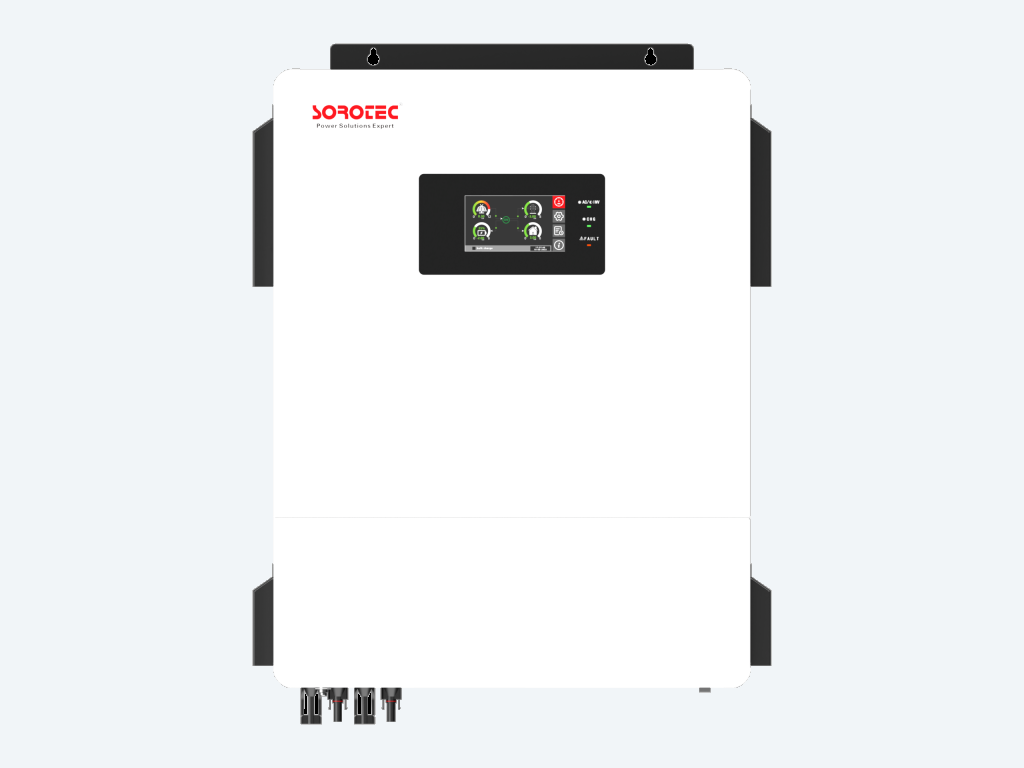
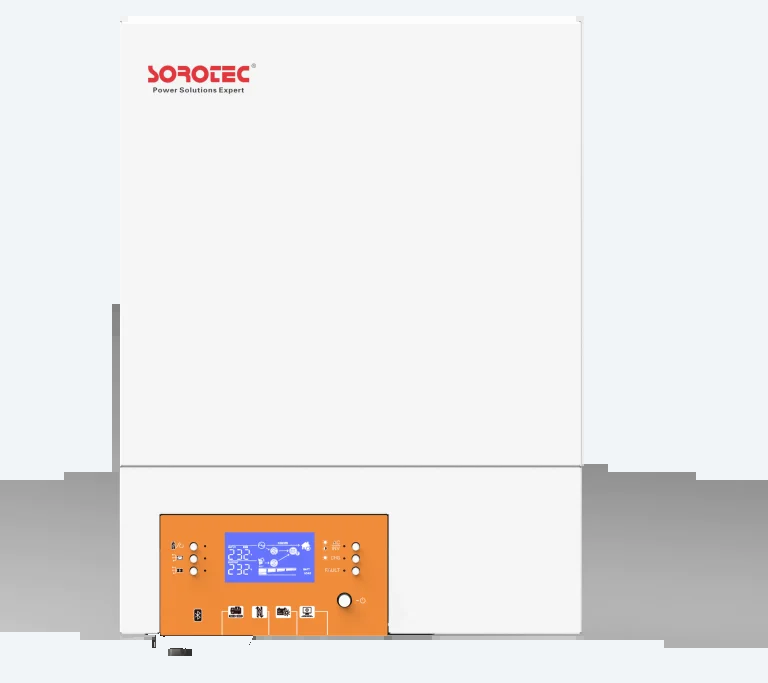
For reference, the REVO HMT IP54 L2P G2 split-phase hybrid inverter comes in 8kW, 10kW and 12kW options. SOROTEC describes native 120/240V output and two independent MPPT controllers. On the family information, you’ll see 60–450VDC for MPPT operation, up to 22A at each controller’s input, and up to 200A for solar charging. Keep the datasheet for the version you’re actually ordering beside those figures. You need its limits to approve a string layout, even if the sales page covers all three power options together.
Read the Input Limits on the Offered Datasheet
Take that 450V entry. It’s the top of the stated MPPT operating range; it isn’t the separate maximum DC voltage you need for the cold open-circuit check. Now look at the 22A entry. Before deciding to parallel strings, find the short-circuit-current limit and the permitted input arrangement too. If connectors or fuses are needed for that arrangement, have them identified in the offer. These are details to settle while choosing the unit, rather than after it arrives.
You’ll need a battery specification as well. The 200A solar-charging entry doesn’t supply one, and it doesn’t rate the AC output. What voltage range does this version accept? Which chemistry and BMS protocol does it support? Get the charge and discharge limits into the reply too, without borrowing a battery voltage from a similarly named unit.
Compare Offers on the Same Basis
| Quotation field | Required detail | Purchase consequence |
| AC power | Exact 8kW, 10kW, or 12kW version | Establishes continuous load capacity |
| Tracker limits | Operating voltage, maximum DC voltage, input and short-circuit current | Determines valid string configurations |
| Module schedule | Module model, series count, parallel count, tracker allocation | Exposes electrical mismatches before ordering |
| Battery interface | Voltage range, current limits, chemistry, BMS protocol | Prevents incompatible storage selection |
| Split-phase capability | Per-leg limits, imbalance allowance, overload conditions | Defines usable 120V and 240V capacity |
Test the Power Choice Against the Load List
Look at where the load connects before adding up its watts.
For each remaining circuit, record operating demand and any motor or compressor starting requirement. Then consider which loads can be on together. This gives the supplier something concrete to assess against continuous output, overload duration and the limit on each leg.
The same sequence underlies split-phase backup load planning: decide which circuits matter, then select the inverter around them. There is no need to assume that every circuit in the service panel must receive backup. Have the supplier return a load assessment showing which circuits the offered version will support.
Buy Battery Capability Alongside Inverter Capability
Can your proposed battery supply the extra demand? A kWh label won’t answer that. Look for the discharge-current limit at the operating voltage, including any restrictions from the BMS. Temperature and state of charge matter here too. If the bank can’t sustain the current, spending more on the inverter hasn’t removed the restriction.
When a quotation includes a backup duration, ask to see how it was worked out. Which loads were running, what reserve was left in the battery, and where were losses allowed for? Use your protected-load profile in that calculation. Two runtime claims can be quite different simply because the suppliers assumed different operating conditions.
A module substitution is easy to overlook when its wattage looks unchanged.
That way, a proposed change has to come back for written acceptance.
Treat IP54 as an Operating Condition
Before approval, check the installation exposure and the conditions specified for the offered unit. The quotation should identify the exact inverter version and account for the installation environment rather than treating the IP54 designation as a substitute for the unit’s operating limits.
Final Checklist Before Ordering
- Confirm whether the 8kW, 10kW, or 12kW version matches the protected-load list and expected continuous demand.
- Request the complete PV string schedule, including module model, series count, parallel count, and tracker allocation.
- Verify operating voltage, maximum DC voltage, input current, and short-circuit-current limits from the exact offered datasheet.
- Confirm the battery voltage range, charge/discharge current limits, chemistry, and BMS protocol for the proposed storage system.
- Have the supplier assess the 120V legs, 240V loads, overload conditions, and any motor/compressor starting requirements.
- If backup runtime is quoted, ask for the assumed loads, battery reserve, and losses used in the calculation.
Conclusion
Dual MPPT inputs are useful when different PV groups need independent tracking, such as different roof exposures. They do not, by themselves, determine whether an 8kW, 10kW, or 12kW inverter is the right choice. The safer comparison is to match the exact inverter version, PV string design, battery capability, and protected-load requirements on the same quotation.
FAQ
Does having two MPPT inputs automatically increase the amount of usable solar energy?
No. Two independent trackers can help when PV groups have different exposure or shading patterns, but the actual benefit depends on the modules and site conditions.
Can I choose between an 8kW, 10kW, and 12kW inverter based only on the PV array size?
No. The choice should be checked against the protected-load list, continuous demand, starting requirements, split-phase leg limits, and the battery’s ability to supply the required power.
Is the 450V figure the maximum DC voltage for the PV array?
Not necessarily. In the source, 450V is described as the top of the stated MPPT operating range. The cold open-circuit-voltage check requires the separate maximum DC-voltage limit from the offered datasheet.
What does the 22A input figure refer to?
The source identifies up to 22A at each MPPT controller’s input. Before paralleling strings, the short-circuit-current limit and permitted input arrangement should also be checked.