

A request for “10kWh of lithium storage” leaves the most important drawing blank. Name the inverter port before making the high voltage vs low voltage battery choice.
What Separates a High-Voltage Solar Battery From a Low-Voltage Battery?
Typical Voltage Ranges and System Architectures
| Design feature | 24V/48V bank | Series stack |
| Voltage | 24V or 48V | From roughly 150V upward, depending on product |
| Usual module connection | Parallel expansion | Managed series stack |
| Design focus | Rising current | Insulation and controlled access |
Either layout may use LiFePO4 cells and a BMS.
Energy Capacity Is Not the Same as Operating Voltage
The label “100Ah” is incomplete until voltage is attached. Quoting nominal kWh, usable kWh and available power alongside it prevents a misleading comparison.
How the Inverter Determines the Required Battery Architecture
Copy these entries from the inverter manual before looking at batteries:
| Copy from inverter sheet | Use in battery review |
| Battery voltage window | Remove incompatible architectures |
| Charge/discharge current | Sets a hard interface limit |
| Battery power | Must cover the intended duty |
| Approved BMS pairing | Confirms more than a shared connector |
How Does Battery Voltage Affect Current and Cable Design?
Comparing Current at the Same Power Level
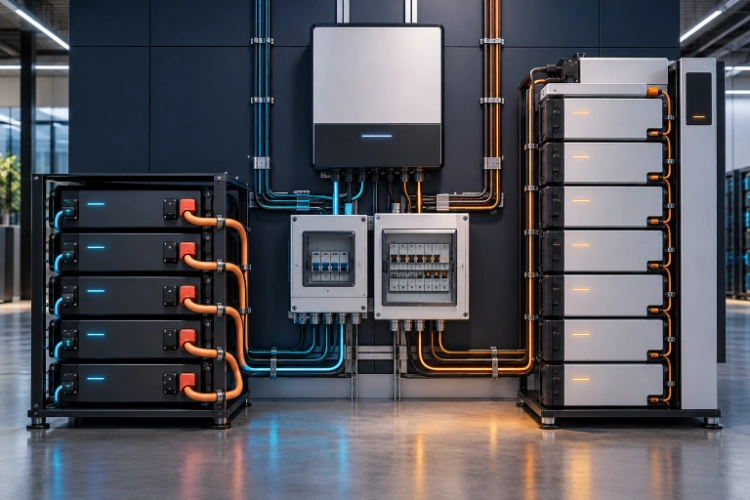
At an ideal 10kW operating point, the arithmetic gives about 208A at 48V and 25A at 400V. These are scale figures before losses—not cable selections. They show why the same inverter power creates very different battery-side hardware.
Cable Size, Voltage Drop, and Heat
Put cable length, terminations and parallel-bank balancing on the layout. Add insulation and test-equipment ratings for a series stack.
Protection Devices and Isolation Requirements
| Item to mark on the single-line diagram | Detail required |
| Fuse or breaker | DC voltage and interruption rating |
| Contactor and pre-charge | Operating sequence |
| Service disconnect | Accessible isolation point |
| Test point | Method used to prove absence of voltage |
Do not approve a protective device until its DC voltage cell is filled.
Why Higher Voltage Requires Stricter Installation Control
Use the product sequence for module order and polarity, followed by grounding, insulation and communication checks.
When Does a Low-Voltage Battery System Make More Sense?
Small Residential and Light Backup Loads
A nearby 48V bank can keep a small backup layout compact. Local parts and service knowledge may settle the choice.
Simple Installation and Service Access
Service access can be simpler when the approved procedure isolates one parallel module. The procedure—not the 48V label—decides when its connector may be opened.
Modular Expansion With 48V-Class Batteries
Add the proposed module to the drawing first. Check its model, firmware and state of charge, then revise cables, addresses and the parallel count.
Current Limits in Higher-Power Applications
Extra parallel capacity adds runtime, not current headroom elsewhere.
When Is a High-Voltage Solar Battery the Better Fit?
Larger Residential and Commercial Storage Loads
When the 48V cable schedule dominates a large project, price a high voltage solar battery alternative. The load profile still sets runtime.
Reducing Battery-Side Current at Higher Power
| At 10kW, before losses | 48V example | 400V example |
| Calculated current | about 208A | 25A |
The cable schedule, not this comparison table, supplies the final conductor size.
Stackable Capacity and System Expansion
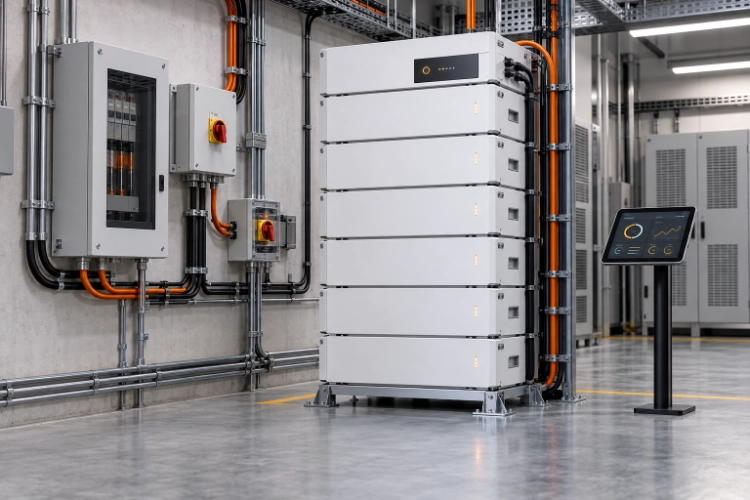
The stack drawing should show the control unit, present module count, permitted minimum and maximum, voltage, and energy. Put later balancing or recommissioning work in the expansion note.
Three-Phase Hybrid Inverter Applications
Check a three-phase unit against finished-stack voltage and power; one module is not the system.
What Compatibility Checks Belong in Every Quotation?
Battery and Inverter Voltage Windows
Show low, nominal and high stack voltage beside the inverter window for the chosen module count.
CAN and RS485 Communication Protocols
Keep inverter, battery, firmware and wiring details in one compatibility record, including the lost-communication response.
Charge and Discharge Power Limits
| Quotation field | Value to request |
| Energy | Nominal and usable kWh |
| Continuous power | kW at stated conditions |
| Peak power | kW and permitted duration |
| Derating | Temperature and state-of-charge basis |
Label each value “module,” “stack” or “system.”
Firmware, Approved Combinations, and Commissioning Settings
Save firmware versions and the chosen battery profile at handover. Photograph both status screens after their module count, voltage, temperature, alarms and current limits agree.
How Should Installers Compare Safety and Maintenance?
Battery Management and Protection Functions
Ask for fault and response together. Warning, current reduction, contactor opening and shutdown are different events; the service team needs to know which one to expect.
Installation Environment and Access
Measure delivery access and floor loading, then record the room’s environmental limits and working clearance.
Module Replacement and Fault Isolation
The spare-module entry should link to isolation, matching and recommissioning instructions.
Warranty, Cycle Conditions, and Documentation
Print the test basis under the cycle figure and the warranty exclusions below it.
How Does the SOROTEC High-Voltage Battery System Fit?
Modular Voltage and Capacity Configuration
SOROTEC’s high-voltage battery system runs from 153.6V/50Ah to 614.4V/100Ah in the published configurations. Compare the battery storage range and matching hybrid inverter range.
Intelligent BMS and Communication Support
Listed features include an intelligent BMS, modular stacking, multiple protections, CAN and RS485. The page states 6,000 cycles, a five-year warranty and design life over ten years; request the applicable test and warranty conditions.
Questions to Resolve Before Finalizing the Quote
Put inverter, load, energy, module count and room conditions in one pack. Contact the technical team for the marked drawing, limits, protection and service steps.
FAQs
Q1: Is a high-voltage battery always more efficient than a low-voltage battery?
A1: No. Cable loss is only one part of system efficiency.
Q2: Can a 48V battery be connected to a high-voltage hybrid inverter?
A2: Only with explicit inverter approval; most such ports sit far above 48V.
Q3: Do CAN and RS485 ports guarantee compatibility?
A3: No. Match communication details and firmware for the exact pair.
Q4: Can capacity be expanded after installation?
A4: Often, within the approved module range. Plan for matching and possible recommissioning.
Q5: What should an installer include in a battery quotation?
A5: Attach the stack drawing and record voltage, energy, power, inverter pairing, protection, warranty and expansion method.
Conclusion
The architecture should remain obvious when the product name is covered. For a high voltage solar battery, the stack drawing and service method are as important as voltage, current and energy. Together they turn “10kWh of lithium” into an installable system.