

An empty battery terminal can be perfectly acceptable on a battery-free hybrid inverter. An unexplained evening supply is not. Before signing the quote, identify what will carry the load after PV stops.
The quote for a hybrid solar inverter without battery should answer four cases in plain language: full sun, weak sun, utility lost, motor starting. Those answers reveal what you are buying.
Can a Hybrid Solar Inverter Run Without a Battery?
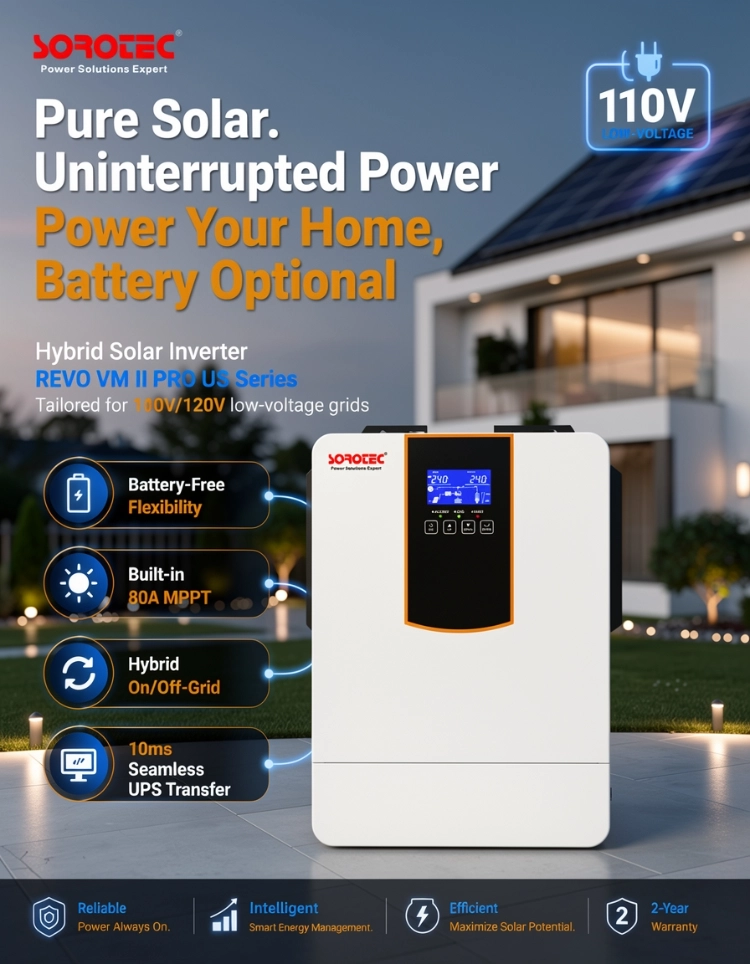
Yes, on models built for it. SOROTEC’s supplied REVO VM II PRO US material shows the 2.2kW unit with no battery attached. Treat that as evidence for the documented model, not every inverter labelled “hybrid.”
Some designs need a battery to establish their DC link or sustain off-grid output. Other architectures leave the terminals unused while PV and utility remain available. Match the quotation to the relevant manual diagram and the broader inverter selection guide.
How Power Flows During Daylight Hours
Imagine a shop drawing 1.4kW from an array currently making 2kW. The load takes its share. The unused portion is curtailed, exported under an approved scheme, or sent to storage if storage exists. The supplied settings and metering determine which.
String calculations still apply. Compare the proposed array with the datasheet, channel by channel: cold-condition voltage, working voltage, then input current.
What Changes When Solar Production Falls
Now PV slips to 700W. The deficit appears before another appliance starts. In an allowed grid-assisted mode, utility power may fill it. Without that help, expect load limiting or shutdown according to the model logic.
Include that cloudy-period response in the purchase specification.
Where a Battery-Free Solar Setup Makes Sense
Draw sunset on the daily load chart. How much consumption occurs before that mark? For an office or daytime workshop, the answer may make direct PV use attractive. Evening-heavy premises present a different case, even if their monthly electricity total is identical.
A staged purchase is possible. The owner can observe evening use before sizing storage, provided battery voltage, charging, chemistry, communication, protection, and space were allowed for initially.
At a remote site, the calculation changes. Generator fallback requires accepted input quality and a checked control sequence; fuel, runtime, and maintenance separate it from utility service.
What Are the Limits of Operating Without a Battery?
The missing component performs a specific job: holding electricity until later. Remove it and the owner must match consumption to production or obtain another supply. Record this before comparing screens or small efficiency differences.
Nighttime Power Availability
After dark, the inverter needs utility power, a generator, or another active source. It cannot supply the evening load from the afternoon’s unused PV. If evening autonomy is part of the brief, storage belongs in the design.
Cloud Cover and Load Fluctuations
Split the load sheet into “running” and “starting” columns. Fill both from equipment data, especially for pumps and compressors, whose short peak can govern inverter selection.
If secondary-output control is available, use it to defer a less important circuit. The remaining supply can then be reserved for the priority circuits, within the same energy budget.
Backup Expectations During Grid Outages
“Battery optional” is not an outage specification. The isolated-output arrangement has to be documented separately. The U.S. Department of Energy makes a similar distinction in its explanation of inverter services: solar-plus-storage can operate without utility support during an outage when the system is designed for that purpose.
Put four questions on the inquiry:
- Can PV start this model with no battery attached?
- Which output operates when utility input disappears?
- What happens when available PV is smaller than the load?
- Can an approved generator take over in that state?
Why 110V/120V Grid Compatibility Matters
Collect the appliance nameplates and distribution-board information. Have the installer identify the actual topology—such as a low-voltage single-phase supply or 120/240V split phase—before specifying the AC version.
The review also needs frequency, neutral and grounding arrangements, accepted utility range, and generator details. Those decisions belong with the responsible designer and local installation requirements.
Build the normal case from equipment that runs together, then calculate the relevant motor-start event. The required capacity comes from those operating cases rather than the sum of every label in the building.
Which Inverter Features Matter in a Battery-Optional Design?
MPPT Input and Solar Array Matching
Find the maximum PV open-circuit voltage, the operating MPPT window, and the current limit. Have the proposed strings checked against all three at the site’s temperature conditions.
An unshaded, uniform array may fit one tracker. Mixed roof directions warrant a closer look, but confirm the internal tracker map instead of counting sockets.
On-Grid and Off-Grid Operating Modes
Give normal supply, export, and isolated backup separate rows in the quotation. For each, have the supplier identify hardware, optional meters, settings, and approvals.
Transfer Time and Battery Expansion Options
The documented REVO VM II PRO US unit lists 10 ms transfer for personal computers and 20 ms for home appliances. Read those figures alongside the operating conditions. A quick switch still requires energy at the destination source.
For future storage, compare the available battery storage options and create a four-line match sheet: battery voltage, chemistry, allowed charge current, and BMS protocol. The words CAN or RS485 describe an interface, not a completed compatibility check.
How the REVO VM II PRO US Series Supports a Flexible Upgrade Path
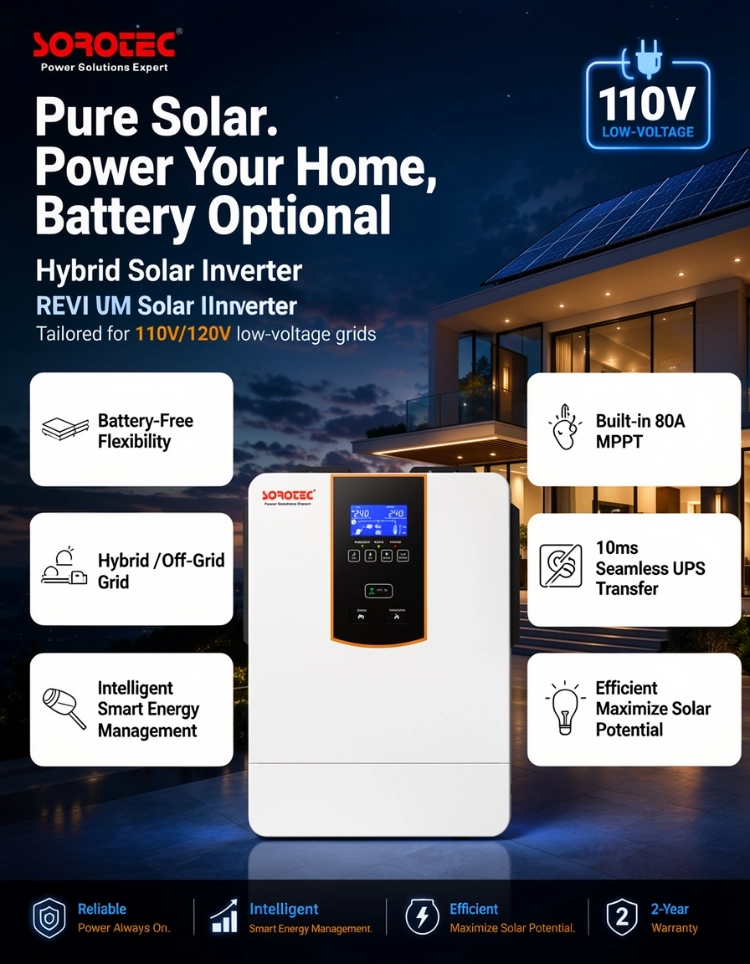
The supplied sheet for the 2.2kW REVO VM II PRO US records:
| Item | Documented specification |
| AC input/output | 110/120VAC |
| MPPT charger | 80A |
| Maximum PV open-circuit voltage | 300VDC |
| MPPT voltage range | 60–260VDC |
| Battery types | Lithium or lead-acid |
| Grid-connected function | Optional |
Match the ordered variant to this sheet. A series name alone does not establish that every option is included.
Send SOROTEC the module datasheet and strings, grid details, simultaneous loads, startup loads, generator information, and desired outage circuits. If storage is planned, say so. Contact the project team and request a matching wiring proposal and operating sequence with the price.
FAQs
Q1: Can a hybrid inverter power a home without a battery?
A1: Yes on suitable models, for circuits within the available PV or utility supply. Whole-home capacity and blackout behavior require separate confirmation.
Q2: Can I add a battery later?
A2: Yes on a suitable unit. First match voltage, chemistry, charging limits, communication, and protection.
Q3: Will a battery-free solar inverter work at night?
A3: Only with another live supply. There is no stored afternoon solar to draw on.
Q4: What should I send with an inquiry?
A4: The electrical supply, module and string data, running and starting loads, backup priorities, and intended storage plan.
Conclusion
Specify a hybrid solar inverter without battery around a particular job: daytime PV use, with an identified source for every gap. Evening autonomy is a different job and requires stored energy. For the REVO VM II PRO US, attach the model diagram and low-solar operating sequence to the quotation before approval.