

Commercial energy storage helps factories and commercial buildings shift electricity use, reduce peak demand, increase solar self-consumption, and support selected loads during grid interruptions. The right design depends on when your site consumes power, how much solar it produces, which loads are critical, and how long stored energy must serve them. Start with those operating needs before selecting batteries, cabinets, or inverters.
How Should A Commercial Site Define Its Storage Goal?
A useful project brief turns broad aims into measurable operating priorities. Decide whether your main goal is peak shaving, time-of-use energy shifting, solar self-consumption, backup support, or a planned combination. Sorotec brings more than 20 years of solar-equipment experience to projects involving power conversion and energy storage.
Match Storage To Load, Solar, And Operating Objectives
Your storage architecture should follow the site’s load profile, solar-generation pattern, working hours, grid limitations, and required discharge duration. A factory with continuous process loads has a different energy curve from an office that empties in the evening.
Each major component has a distinct role. The battery stores energy. The power conversion system manages conversion between DC and AC power. The energy management system controls charging and discharging according to operating schedules, tariffs, and site priorities. When solar and batteries must work together, a hybrid solar inverter can coordinate PV generation, storage, loads, and grid interaction within the selected electrical design.
| Operating goal | Storage action | Buyer input required |
| Peak shaving | Discharge during high-demand periods | Interval demand data and peak-load profile |
| Time-of-use shifting | Charge and discharge around tariff periods | Current tariff structure and operating schedule |
| Solar self-consumption | Store surplus PV energy for later loads | PV generation curve and daytime consumption |
| Backup support | Supply designated circuits during an outage | Critical-load list and required support duration |
Separate Factory And Commercial-Building Requirements
Factories may have motors, process equipment, large starting currents, shift-based demand, and loads that cannot tolerate an unexpected stop. Offices, retail properties, warehouses, and mixed-use buildings may place more emphasis on lighting, HVAC, refrigeration, communications, security, or tenant circuits.
Available electrical space and environmental exposure also matter. Indoor electrical rooms, shaded semi-outdoor walls, and exposed outdoor equipment areas call for different enclosure strategies. No single commercial energy storage architecture fits every property. Complete a load study and electrical design review before committing to equipment.
Establish The Required Scale Before Selecting Equipment
Connected load alone does not determine system size. Review coincident peak demand, PV capacity, battery energy capacity, expected charge and discharge windows, and the operating strategy. Power rating determines how quickly the system can supply energy; energy capacity affects how long it can continue.
Do not apply a broad commercial power band as an automatic purchasing rule. Confirm the required system-level output first, then check whether one unit or an engineered multi-unit arrangement can meet it. Parallel operation must be verified for the exact inverter model and configuration rather than assumed.
Which Inverter Architecture Fits The Site?
The inverter decision connects the energy strategy to the building’s electrical service. Phase arrangement, PV input design, battery compatibility, environmental protection, and operating thresholds all need to be reviewed together.
Use A Hybrid Solar Inverter When Solar And Storage Must Work Together
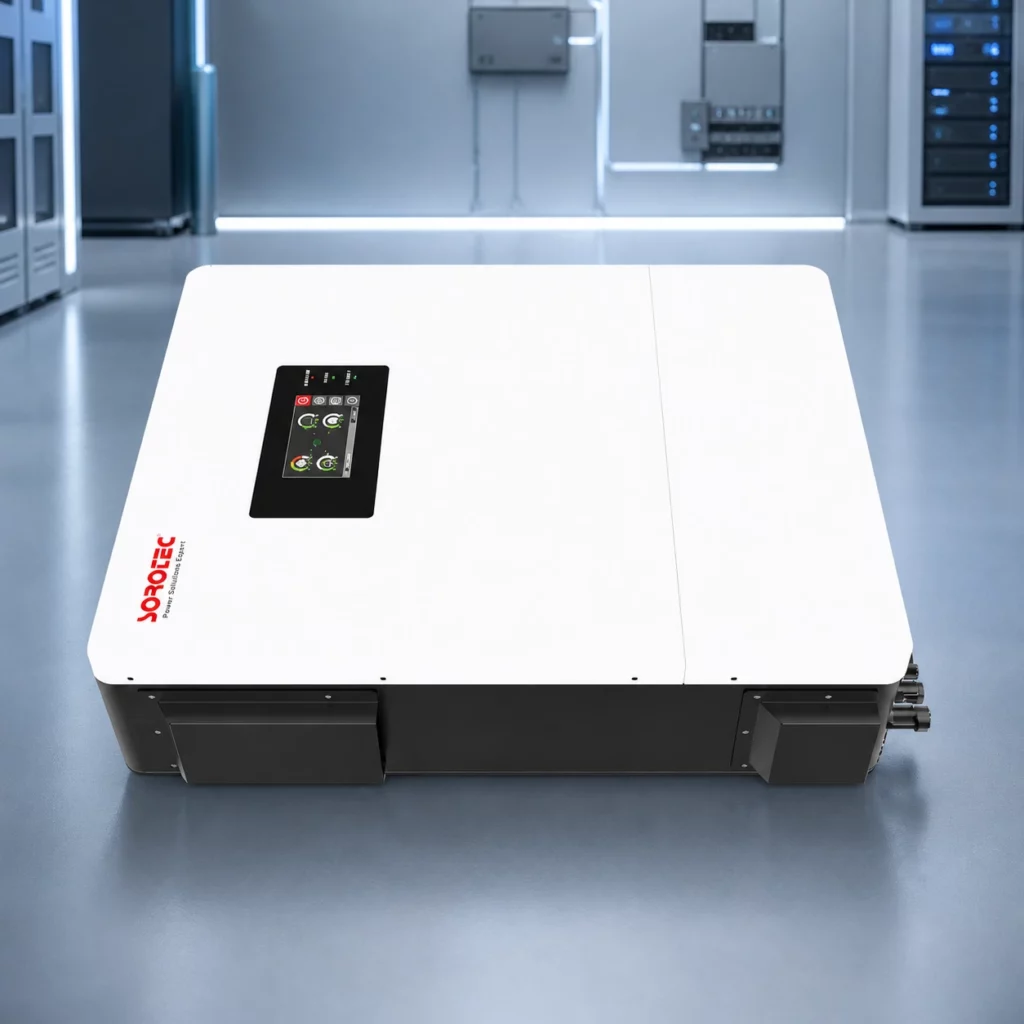
A hybrid solar inverter combines solar-inverter and battery-inverter functions, allowing one device to manage PV power, battery charging and discharging, loads, and grid exchange according to the system design.
REVO VM II PRO should be treated as a hybrid solar inverter. However, do not specify it for a factory or commercial building until its power range, phase arrangement, battery compatibility, MPPT limits, protection rating, startup thresholds, and parallel capability have been checked for the proposed configuration.
For a confirmed three-phase option, the Three-Phase IP54 REVO HMT IP54 L3P G2 Hybrid Energy Storage Inverter 6-12kW offers 6–12kW models, IP54 protection, a maximum 800VDC PV input, and a 200–650VDC MPPT operating range. Its suitability still depends on system scale, load characteristics, and electrical design.
Choose Phase Configuration Around The Building’s Electrical Service
Match the inverter to the service entrance and downstream equipment. Three-phase systems are commonly relevant where industrial machinery or larger commercial loads are present. Split-phase equipment must match sites using that distribution arrangement. Single-phase units require the same service-level compatibility check.
The Split-Phase IP54 REVO HMT IP54 L2P G2 Hybrid Energy Storage Inverter 8-12kW supplies 120V/240V split-phase output, comes in 8kW, 10kW, and 12kW options, and has an IP54 enclosure for suitable semi-outdoor locations.
| Confirmed inverter | Phase arrangement | Power options | PV-related facts |
| REVO HMT IP54 L3P G2 | Three-phase | 6–12kW | 800VDC maximum PV input; 200–650VDC MPPT range |
| REVO HMT IP54 L2P G2 | Split-phase | 8kW, 10kW, 12kW | Two independent MPPT controllers; up to 22A input per controller; 60–450VDC operating range |
Before procurement, review the approved datasheet, installation manual, and project design package for service voltage, load balance, battery interface, protection devices, communications, and installation clearances.
Evaluate MPPT Capability Against The PV Design
MPPT current should be checked against module-string current, the number of parallel strings, irradiance conditions, tracker allocation, and array voltage. A current figure considered by itself cannot establish compatibility.
Clipping is determined by the DC/AC relationship, not simply by high PV input voltage. Likewise, a high-voltage architecture does not inherently prevent clipping. Startup thresholds deserve separate attention: under weak dawn or dusk irradiance, a higher threshold can delay startup or bring shutdown forward compared with a lower-threshold design.
What Equipment And Protection Features Matter In Deployment?
After choosing the electrical architecture, assess how the system will be installed, protected, controlled, and maintained. Commercial energy storage equipment may be distributed across separate components or assembled in a centralized cabinet.
Consider An Integrated Outdoor Storage Cabinet For Centralized Deployment
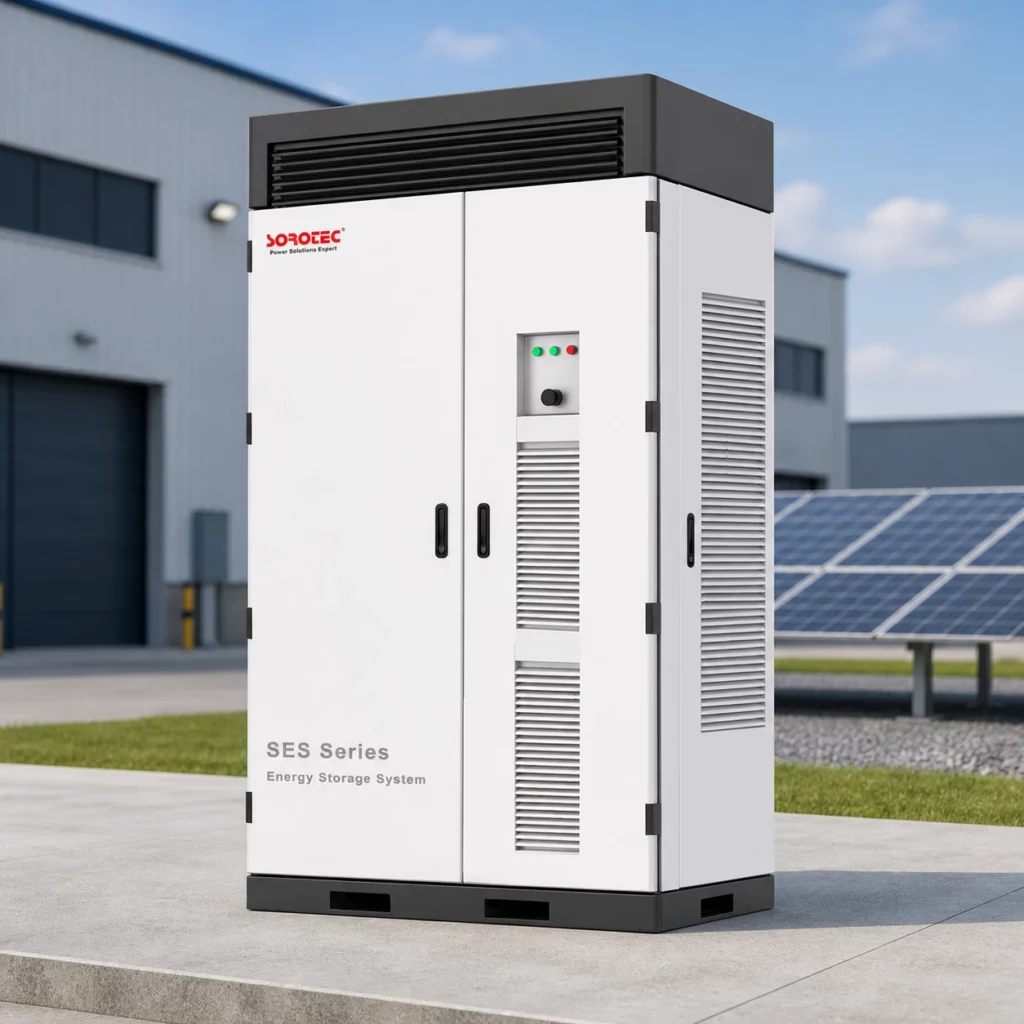
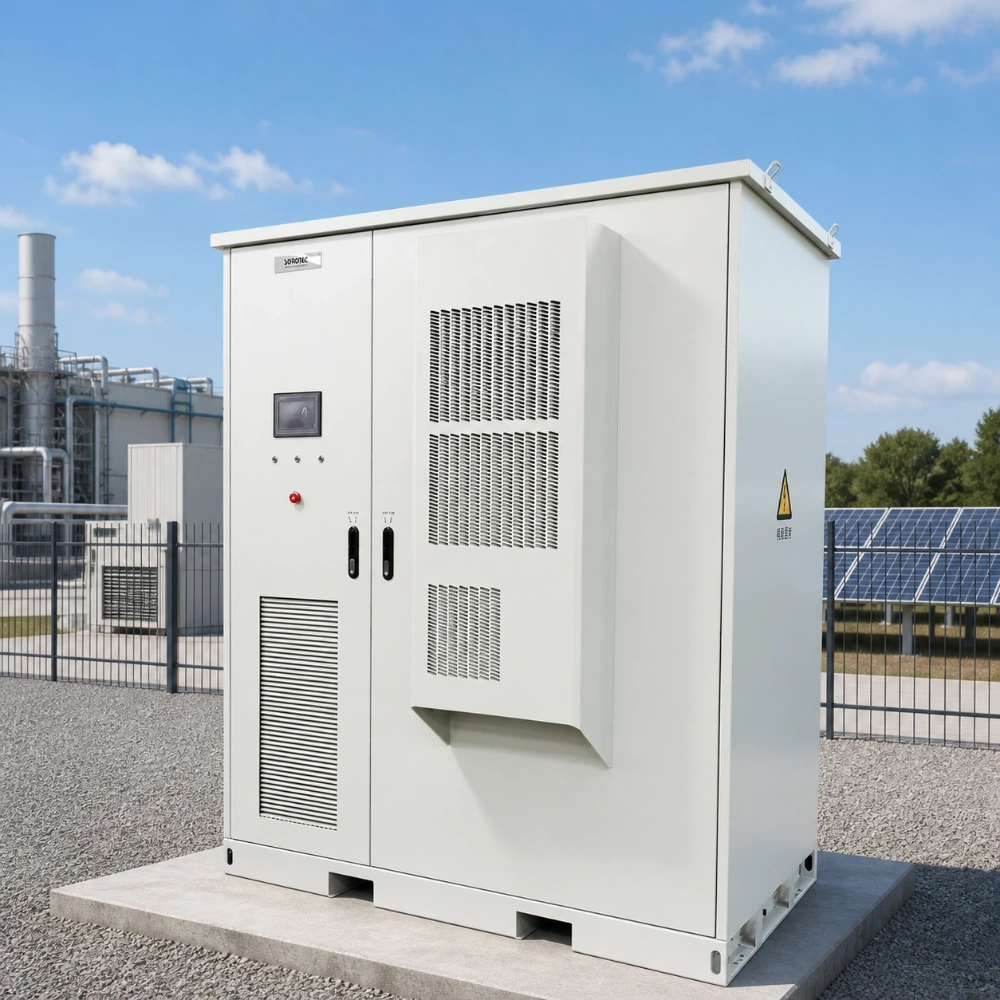
The SES Integrated Energy Storage System IP55 Outdoor Cabinet 100-215kWh Capacity \| -40°C to +55°C Wide Temperature- SOROTEC is a centralized option for outdoor deployment. Its 215kWh pre-assembled configuration integrates the battery, PCS, thermal management, and fire suppression in one floor-installed cabinet.
The system carries IP55 protection and an operating-temperature range of -40°C to +55°C. Its electrical interfaces include a 670–1000VDC battery range, 200–850VDC MPPT range, and 380/400VAC grid connection. The built-in EMS supports time-of-use charging and discharging schedules, including peak-shaving and valley-filling strategies.
Check Controls, Protection, And Site Conditions Before Procurement
Compare enclosure ratings with actual exposure to dust, water, temperature, and installation conditions. Also review fire suppression, thermal management, isolation, maintenance access, communications, and the division between critical and noncritical loads.
Commercial energy storage procurement should conclude with a coordinated load study, single-line diagram, PV string design, operating schedule, and model-level compatibility review. You can review Sorotec’s wider product portfolio and discuss load, phase, environmental, and control requirements through the appropriate commercial project contact.
FAQ
What is commercial energy storage used for in a factory?
It can shift energy between tariff periods, reduce peak demand, store surplus solar generation, and support selected factory loads. The required power and battery capacity depend on process loads, operating shifts, demand peaks, and the desired discharge duration.
Can one commercial battery system back up an entire building?
It can only do so when the complete system is sized and designed for the building’s load, starting currents, phase configuration, and required backup time. Many projects instead separate critical circuits from loads that do not need backup.
How do you choose a hybrid inverter for commercial energy storage?
Match the inverter to the building’s service phase, required output, PV voltage and current, battery interface, enclosure conditions, and control strategy. Confirm startup behavior, MPPT limits, communications, and any required parallel-operation capability for the exact model.