

A power cut reveals more than the bill. Cold storage and the payment router may need power immediately; the pump can wait for stronger sun, and comfort cooling can wait longer.
Use that operating sequence when requesting a commercial solar system in Zambia or Burundi. State the main job plainly: daytime savings, outage cover, off-grid supply or generator support. Each answer produces a different design.
Regional Data Is Context Not a Load Schedule
Burundi Access and Service Conditions
Burundi’s location changes the brief sharply. A World Bank diagnostic based on survey data reported grid access near 68% in urban areas but about 3% in rural areas. A business outside the cities may therefore be planning around off-grid supply, difficult service access or both.
The national figures still cannot size a battery. Consider two buyers: one has a weak feeder plus a generator; the other has no utility connection and a long road for service visits. Both say “backup”, yet only the first can normally expect an overnight grid recharge.
Zambia Hydropower and Supply Risk
World Bank data records Zambia’s 2024 electricity access at 53.6%. The country’s supply also leans heavily on hydropower. In its 2026 review, the Bank said hydro represented more than three quarters of installed capacity and that the 2024 drought reduced available power by about one third. Rather than copy that event into every forecast, ask which work the site would postpone during another tight period.
Translate Regional Risk Into Site Questions
Four questions bring that issue down to site level. How long are typical outages? Does voltage sag before the power disappears? What is the delivered cost of diesel? Which part of the year puts the most pressure on supply?
Walk the Circuits Before Choosing the Inverter
Record Running and Starting Loads
Begin at the distribution board and trace each critical circuit. Some loads are steady; pumps and compressors are different because their start can be the largest event on the board. Record that surge separately from the running load.
Separate Critical and Flexible Loads
Define the smallest shift that still earns revenue. A grocer might retain the cold room, till, router and a few lights. A workshop could keep its office and one machine, leaving welding or pumping for solar hours. This decision often changes battery cost more than a minor efficiency difference.
Account for Seasonal Operation
Use the busy season as a separate case. Milling, irrigation and cold-storage schedules change through the year, so test the peak month first and the quiet month second.
Label each circuit backup, daylight or off, then add watts, starting demand and hours. Also record operating rules. If staff never start two motors together, exclude that artificial peak from the design.
Battery Capacity Is Not the Same as Runtime
Calculate Nominal Energy
The nominal energy is 15.36 kWh, calculated from 51.2 V and 300 Ah:
51.2 × 300 ÷ 1,000 = 15.36 kWh
Estimate Usable AC Energy
Usable AC energy is lower after reserve, discharge limits and conversion loss. Temperature and age also matter. Using 80% available energy and 92% efficiency leaves about 11.30 kWh in this example, or roughly 2.26 hours at a steady 5 kW load.
This arithmetic is only a sense check. Once a battery model is selected, use its manual and the actual project settings for the runtime estimate.
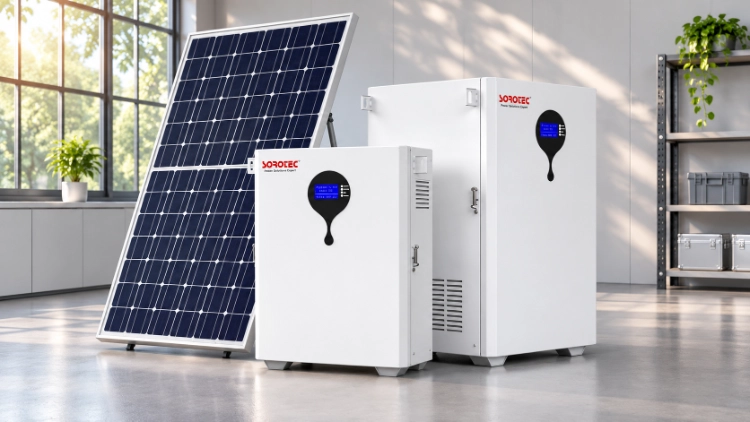
Because the SL range contains several models, require the exact SKU and its current limits on the offer.
Check 11 kW Against Battery Current
Check the REVO VM V Inverter Side
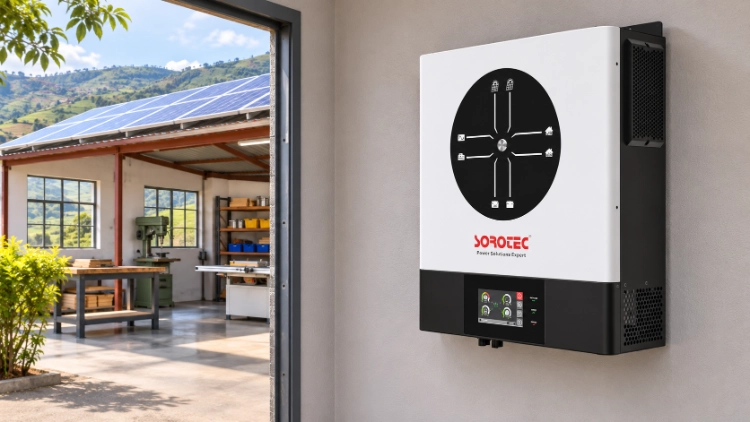
SOROTEC lists REVO VM V as a 6-11 kW hybrid family for grid-connected and off-grid use. The page notes CAN and RS485 communication and parallel operation of up to six inverter units. Battery compatibility remains a separate check.
Check the SL Battery Side
On the SOROTEC SL battery page, SL-51.2300 appears as a 51.2 V, 300 Ah model. Continuous discharge is described as model-dependent, reaching as high as 200 A within the family. The phrase “model-dependent” cannot be dropped from the quotation.
Compare DC Current With Battery Limits
Now view 11 kW from the DC side. At 51.2 V, the current is already about 215 A before losses:
11,000 ÷ 51.2 ≈ 215 A
That current is why the two nameplates cannot be paired by capacity alone. The written compatibility check needs the battery’s continuous and peak ratings, the inverter DC limit, battery quantity, parallel rules, protocol and cable pinout.
The answer can still be one battery when the protected load is much smaller and the manufacturer approves the duty. Or it can be several batteries when high power and longer runtime are genuine requirements. Either is better than hiding the assumption.
Do Not Leave Service Until the Last Page
Plan Commissioning and Spare Parts
A missing communication lead can delay an inland installation longer than the largest cabinet. Order the small accessories and agreed spares with the system. Give commissioning to a named technician, including firmware and BMS work.
Complete Site Protection and Generator Planning
At site, settle earthing, lightning, ventilation, dust and cable protection. Keep the generator? Then choose its role on paper: loads, charging, or both. Check that choice against the inverter manual.
Send a Quote Request That Can Be Checked
A short RFQ is fine when its inputs can be checked. Attach the load sheet and site photos, then state the town, electrical service, usual outage, required runtime and generator plan. Ask for separate lines for batteries, protection, monitoring, freight and commissioning. The supplier should show which motor start set the inverter size and who confirmed battery communication.
That is the purchasing rule worth keeping: buy the operating plan, not two impressive numbers. Send SOROTEC the site data and load schedule through its contact page and request current documents for the exact REVO VM V and SL variants proposed.
FAQ
How is battery runtime estimated
Reduce the nominal 15.36 kWh for reserve, discharge limits and conversion loss, then divide by the protected load. Confirm the result against the chosen model and settings.
Is one 300 Ah battery enough for 11 kW
Check current before saying yes. Full output is about 215 A before losses. One battery may suit a much smaller protected load, but its current limits, BMS, cabling and parallel rules must support the proposed duty.
What stays on when the grid fails
Choose at the distribution board. Keep the circuits needed for safe trading, move flexible machinery to sunny hours, and disconnect the rest during a cut. The exact list depends on how that business earns money.
What belongs in the RFQ
One page is often enough if the inputs are real: town, electrical service, normal outage, load table and runtime target. Add the generator plan and site photos. Ask for exact inverter and battery codes, then make the supplier separate protection, monitoring, commissioning, spares and support in the reply.