

A tidy row of 6, 8, 10 and 12kW models can disguise a gap. Picture the next RFQ: 120/240V service. The local warehouse holds 230V single-phase units. None of the four ratings solves it.
This is a portfolio problem, not a missing-wattage problem. Phase architecture belongs beside voltage and project type at the top of the stock plan. If phase appears only on page four of the brochure, a price may already have gone out against the wrong family.
Apply that test to suppliers, too. Ask a hybrid inverter supplier for a range map, the document set behind each branch, and the name of the route for exceptions. Without those three items, a long catalogue is hard to operate.
Why Phase Architecture Should Shape Distributor Inventory
A Power Rating Does Not Define Grid Compatibility
Three 10kW cartons may be headed to three different drawings: conventional single-phase, 120/240V split-phase, and three-phase. Capacity-based inventory codes hide that difference. Electrical drawings expose it immediately.
Look at the AC side instead: conductors, neutral, both relevant voltages, and load distribution. Then look at the backup output. The number printed before “kW” settles none of this.
On the internal model list, place “AC architecture” before “rated power.” Now pricing starts inside the right family, and wattage becomes a comparison rather than a guess.
One Sales Territory Can Contain Several Project Types
The delivery map may show one region; its switchboards will not show one pattern. Flats, farms, houses, workshops, shops and small factories bring different services and different loads.
Use the recent RFQ log to justify stock. Record service, voltage, backup duty, size and location, plus a blunt loss code: “phase family unavailable.” That code shows a gap a bestseller list cannot.
Weekly split-phase enquiries and occasional named three-phase projects call for different treatment. Keep the former close; give the latter a tested order route. Equal shelf space would only make the warehouse look balanced.
Build the Product Mix Around Three Customer Segments
Single-Phase Products for Mainstream Residential and Light Commercial Work
Place a single phase hybrid inverter in this lane only after the service and protected circuits check out as single-phase. After that come battery interface, enclosure, operating mode, site limits and power.
Do not let the word “residential” choose the unit. A split-phase house and a conventional single-phase house look identical in a sales presentation. Their boards do not. Request the voltage and a board drawing.
Shelf space goes to configurations that repeat. Slower power or enclosure combinations can sit on a project-order list with a real lead time, rather than gathering dust as proof that the catalogue is “complete.”
Split-Phase Products for 120/240V Residential Storage Projects
Create a separate SKU class for the split phase hybrid inverter. Its RFQ needs both voltage relationships, the neutral arrangement and a marked list of circuits entering backup.
Do not begin with the grand total. Mark 120V lighting and receptacles, then the 240V pump, dryer, air conditioner or charger, and note the leg for every backed-up circuit. Add the totals last.
Split-phase documents need their own folder. Pooled “residential” files invite an embarrassing combination: correct price, incorrect manual.
Three-Phase Products for Larger Buildings and Multi-Phase Loads
Put an enquiry in the three phase hybrid inverter lane because of its service, not because the kW number looks large. The working file will usually include an EPC drawing, facility loads, protection notes and design comments.
In that file, note sequence, voltage, frequency, expected imbalance, backup duty, battery interface and communications. Leave an unknown field visibly open. A blank with an owner is better than a specification invented to make the table look finished.
Shallow three-phase stock can still work. Keep the documents current, quote the real lead time and assign a technical reviewer. A dozen unsupported listings collapse at the first submittal query.
Use a Quote Matrix Instead of a Flat Product List
Record the Service Before Discussing Capacity
The first page of the RFQ form can be short:
| Required field | What it prevents |
| AC service and conductor arrangement | Choosing the wrong phase family |
| Both AC voltage relationships | Guessing from a country or building label |
| Frequency | Sending a model for the wrong destination |
| Protected-load schedule | Hiding continuous, surge, or leg-specific demand |
| Installation location | Overlooking enclosure and environmental limits |
Only then move to battery voltage, charging and discharging limits, PV inputs, communications, and operating mode. A request reading “10kW hybrid inverter, best price” is not ready for a final quote. It is ready for a reply with the missing fields highlighted.
Separate Stock Models From Project-Order Models
One practical stock code uses three labels:
1. Core stock: repeat configurations with local installer familiarity and predictable replacement demand.
2. Controlled stock: genuine but intermittent demand, so quantities stay small.
3. Project order: a unit purchased after the technical submittal is accepted.
The labels remove ambiguity from sales calls. “Available” can mean ships today, held in limited quantity, or available from production. Those are very different promises to a buyer planning an installation date.
Spare-unit planning also becomes clearer. Core models need a stronger local service position. A project-order model may instead need agreed spare parts, remote support, or a replacement plan written into the commercial offer.
Make Every Proposed Substitution Visible
Requested model and quoted model are different? Add a deviation row. It should show the change, the reason and the drawing or approval still due. A new part number does not explain itself.
Moving up one rating inside an approved family may be routine. Moving from split-phase to single-phase is an architectural change. So is offering a large single-phase unit against a three-phase request. The buyer needs to see that before issuing the purchase order.
Four entries are enough for the record: request, proposal, exception, approval. The next revision starts there instead of in a search through old email.
Map SOROTEC Product Families to Clear Sales Roles
REVO HES for Single-Phase Outdoor-Focused Projects
SOROTEC’s REVO HES single-phase hybrid inverter page gives the essentials: 6/8/10kW and IP66. On the range map, place it under single-phase projects whose checked site conditions suit that enclosure.
IP66 is one cell, not the installation verdict. Pair it with the manual and the site’s temperature, sun, airflow, mounting and cable entries. Attach documents for the named model.
REVO HMT L2P G2 for Split-Phase Projects
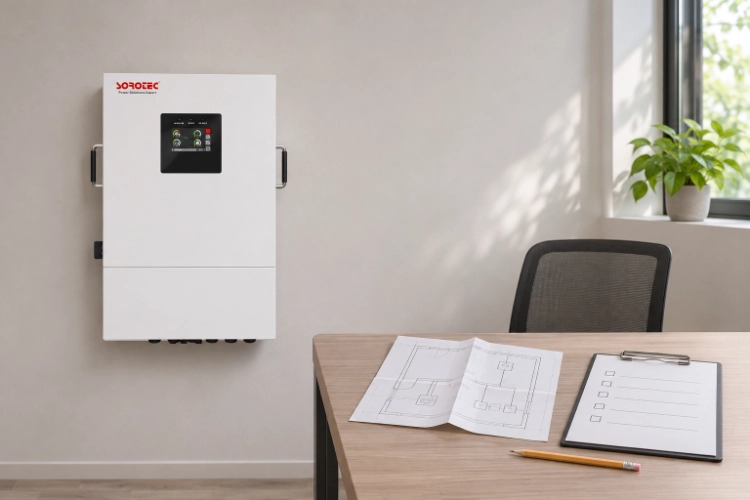
The official REVO HMT L2P G2 split-phase inverter family entry reads 8/10/12kW, 120/240V and IP54. Match that entry to a project with split-phase service and the corresponding mixed-voltage loads.
Next, lay the backup schedule beside the selected rating and check the proposed location. The family name routes the enquiry. The project documents decide it.
REVO HMT L3P G2 for Three-Phase Projects
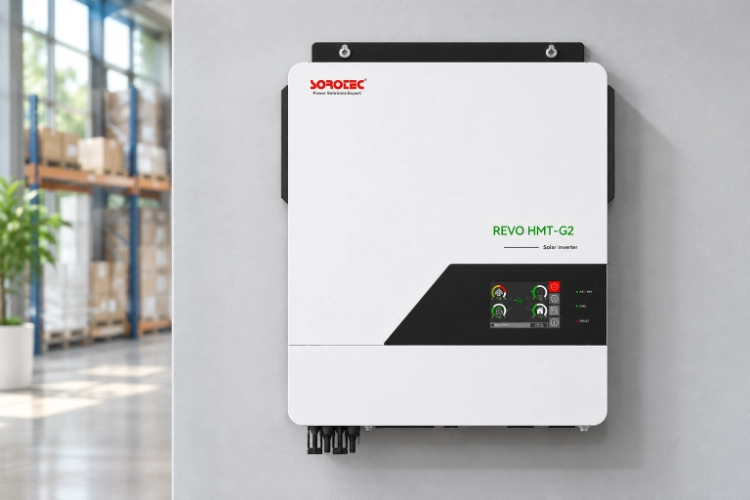
SOROTEC lists REVO HMT L3P G2 in 6/8/10/12kW, IP54, on its three-phase inverter family page. That is a cleaner starting point for smaller three-phase storage work than adapting a residential proposal.
“Three-phase required” is the file name, not the finished brief. Add voltage, frequency, load distribution, backup duty, battery arrangement and the connection drawing before keeping a variant on the quote.
Together, they make a coherent solar inverter product range: related equipment, three electrical jobs. A price column should not imply interchangeability.
What Documents Should Travel With Each Product Family
Build a Phase-Specific Sales Pack
Use a controlled folder for each family. The index can be plain: datasheet, manual, model list, approved wiring material, available battery-compatibility information, warranty terms, product page. Date every entry.
The benefit appears in the next sales email: one consistent attachment set. Where architectures share a sheet, make model, voltage and phase readable in the row itself, not in distant footnotes.
A hybrid inverter supplier should also name the route for exceptions. Ordinary RFQs can stay with sales. Unusual service arrangements, mixed loads, parallel proposals, and departures from published diagrams need a technical reviewer.
Prepare the Commissioning Handover Before the Order Ships
Finish the handover before dispatch. Check off model, manuals, settings, one-line, protection schedule, battery communications, serial-number handling and the commissioning list. Beside an open carton, a missing document has already become a site problem.
U.S. Department of Energy guidance for commercial and industrial PV commissioning names documentation, array testing and whole-system performance testing. The distributor may not carry out those tests; its paperwork still feeds the process.
Engineers, codes, utility rules and manufacturer instructions still govern. The pack simply gets the right material onto their desk.
Avoid Three Product-Portfolio Mistakes
Offering One Phase Type in Too Many Power Ratings
A shelf can hold five single-phase ratings and still have no answer for a split-phase RFQ. Adding wattages deepens one part of the range. It does not create another AC architecture.
Add “wrong phase family” to the lost-enquiry report. Without that reason code, management may respond to missed sales by ordering more of the very family that could not serve them.
Treating Parallel Operation as Phase Conversion
Parallel operation sometimes adds capacity. That does not make it a universal phase converter.
The exact manual must allow the topology, unit count, communications, protection, battery sharing, firmware and commissioning method. No diagram, no promise: hold the connection out of the quote until it is confirmed.
Letting Marketing Names Replace Electrical Drawings
“Residential,” “commercial,” “US model,” and “European model” are catalogue labels. None of them states the conductor arrangement. Print the actual voltages beside the label and add the one-line.
One sales inbox may serve regions that use familiar terms differently. Open the drawing and skip the argument.
FAQs
Q1: Can a distributor replace a three-phase inverter with a larger single-phase model?
A1: No. A larger single-phase box remains single-phase. Check the service first, followed by voltage, loads and protection.
Q2: Is split-phase the same as two-phase or three-phase power?
A2: No. Here, split-phase describes single-phase, three-wire service with two voltage relationships. Keep that wording on the quotation and one-line; do not relabel it as three-phase.
Q3: Should every phase architecture be kept in local stock?
A3: No. Stock the combinations that repeat and that the local team can support. Put rarer variants through project order, with the lead time stated before the buyer plans the job.
Q4: What information should a buyer send before requesting a quote?
A4: Start with service type, both AC voltage relationships, frequency and a one-line. Add the backup load list, surges, battery and PV data, location, operating modes and destination. A board photo helps explain the site; it is not a measurement or drawing.
Conclusion
Equal piles of all three inverter types would look tidy and prove little. What matters is a working lane for each: stock status, RFQ fields, current documents and an owner for exceptions.
SOROTEC’s single-phase, split-phase and three-phase families fit that structure without pretending to substitute for one another. Read the service first. Then choose the rating. That order is less likely to produce a nasty surprise when the switchboard is opened.