

Small commercial sites rarely treat every circuit the same way. A shop may need its payment terminal, lights, router, and refrigerator during an outage, while a water heater or workshop tool can wait. A dual-output hybrid inverter separates those priorities. The SOROTEC range includes models with two outputs, battery communication, and programmable operating modes. The design task is to assign outputs honestly and check PV and battery limits.
Key Takeaways
- Treat output 1 as the protected group and output 2 as a controllable group only after measuring the loads.
- Check voltage, PV current, battery protocol, and parallel operation together; a dual-output label alone is not a system design.
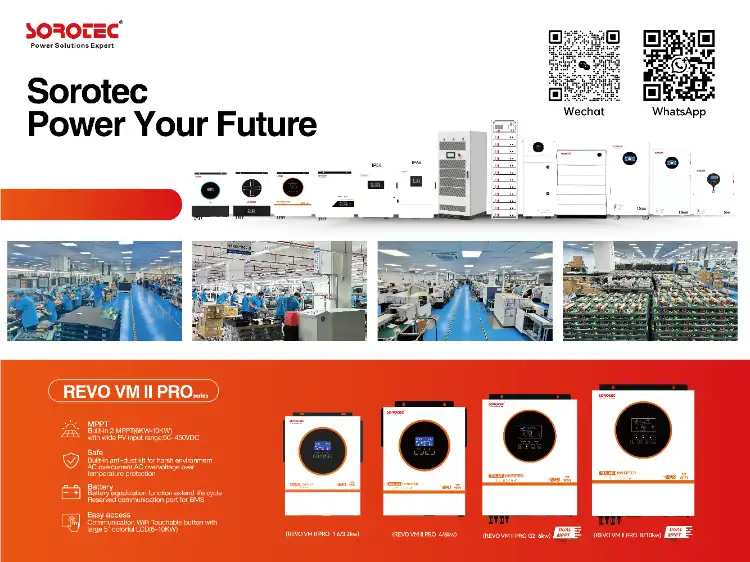
- The REVO VM IV listing specifies 4/6kW options, a 27A maximum PV input current, two smart-load outputs, and operation with up to six units in parallel.
- The REVO HMT listing adds a 60–450VDC PV range, CAN or RS485 BMS communication, configurable AC/PV priorities, and dual outputs.
- This approach suits small shops, offices, workshops, and service buildings. It is not a substitute for a properly engineered 50–300kW commercial energy-storage plant.
Separate Critical Loads from Flexible Loads
Load management works when electrical priorities are clear. List equipment over a typical day, then mark each circuit as critical, flexible, or unsuitable for backup. The owner and electrician should agree on the labels.
Protect the Loads That Keep the Business Open
Output 1 should carry circuits that must remain available: network equipment, point-of-sale devices, security, emergency lighting, refrigeration controls, or a small server. Add running watts and check startup pulse. Keep the list short enough for the required outage window.
Schedule Loads That Can Wait
Output 2 can serve a pump, water heater, workshop tool, air conditioner, or other circuit that can be delayed. The goal is controlled shedding, not a promise that every load runs at once. Label the distribution board clearly.
Check the Restart Sequence
Some equipment restarts smoothly after a short interruption; compressors and drives may not. Confirm the restart requirement and test it during commissioning. If output 2 is scheduled on at midday, check that battery state of charge and inverter reserve can accept the step load.
| Load group | Typical treatment | Question for the installer |
| Critical | Always supplied within the backup plan | What is the required runtime and surge? |
| Flexible | Enabled by time, battery state, or tariff | When can it pause without disrupting work? |
| Non-backed-up | Remains on the utility side | Does it need a separate manual bypass? |
| Motor load | Requires a start and restart check | Is the surge duration within the inverter limit? |
Verify the Inverter Architecture and Solar Input
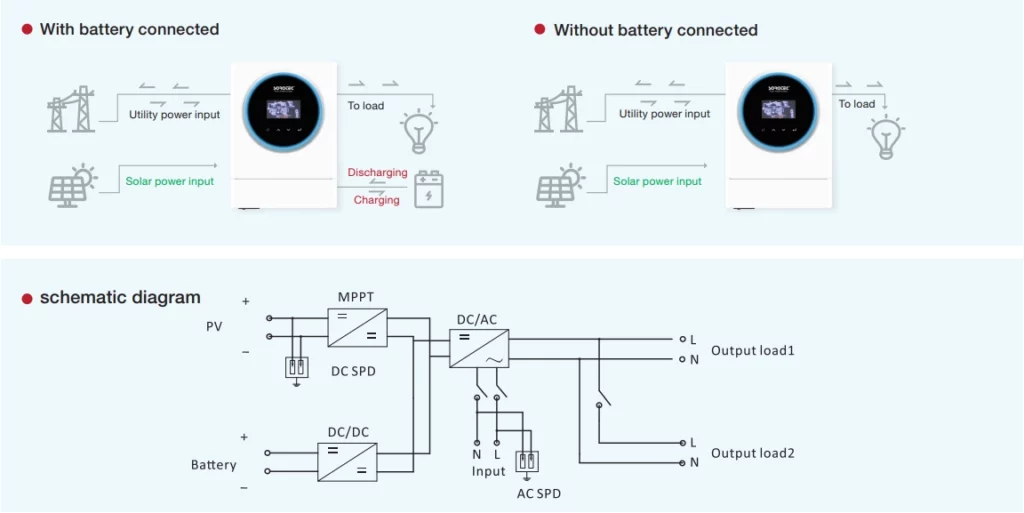
After the load groups are agreed, compare inverter data with the PV array and service. Dual outputs are useful only when the conversion stage, battery interface, and control logic support the schedule.
Read the PV Current Limit Correctly
The REVO VM IV product page lists a 27A maximum PV input current. Check module short-circuit current, operating current, parallel strings, and local temperature correction before adding panels.
Use the 60–450VDC Window on the REVO HMT
The REVO HMT listing specifies a 60–450VDC PV range and a reserved CAN or RS485 port for BMS communication. Check the range at the coldest open-circuit voltage and hottest operating condition. A string that looks correct in mild weather can move outside the window in the field.
Confirm AC and Battery Priorities
The product information lists configurable AC/PV usage time and prioritization for the REVO VM IV and REVO HMT families. Confirm whether the site wants PV first, battery first, or grid support. Set a battery reserve so output 1 remains protected.
| Checkpoint | REVO VM IV listing | REVO HMT listing |
| Power range shown | 4kW and 6kW | 4kW, 6kW, and 8kW variants listed |
| PV input | Maximum 27A | 60–450VDC PV range; current depends on the selected model |
| Load control | Two smart-load outputs | Dual outputs with configurable priorities |
| Battery interface | Reserved CAN or RS485 BMS port | CAN or RS485 BMS communication |
| Expansion | Up to six units in parallel | Up to six units in parallel |
Pair the Battery and BMS with the Control Plan
A dual-output hybrid inverter is only as predictable as its battery limits. The BMS should report state of charge, charge and discharge limits, temperature alarms, and fault status. If the battery is not on the approved compatibility list, ask for a written integration method before ordering.
Keep the Reserve for the Protected Group
Set a reserve percentage or voltage threshold that protects output 1. During a long outage, output 2 should shed first. This is what turns dual outputs into a business continuity tool.
Size the Battery for Energy, Not Just Power
Battery power must cover the highest simultaneous load. Battery energy must cover the hours the critical group needs. Usable runtime still depends on protected load, discharge limit, temperature, and reserve setting.
Test a Communications Failure
During commissioning, simulate a BMS signal fault according to the manufacturer’s procedure. Confirm a safe state, fault report, and charge limit. Record firmware and cable pinout in the handover pack.
The REVO VM IV hybrid inverter is a sensible starting point for a small commercial project that needs two smart-load outputs, a 27A PV input ceiling, and a path to parallel expansion. For a wider 60–450VDC design with the same load-control idea, review the REVO HMT series and confirm the exact variant before the quotation.
Write the Operating Rules Before Commissioning
The owner should receive a one-page operating schedule. It should explain when output 2 can run, what reserve is protected, who may change the schedule, and which alarm requires service.
Use a Simple Daily Schedule
For a shop, output 2 might run during solar-rich hours and pause during the evening peak. For a workshop, it might run only after the battery exceeds the agreed reserve. Write the clock times into the commissioning record.
| Operating condition | Output 1 | Output 2 | Control action |
| Grid available, PV strong | Critical circuits | Flexible circuits if battery reserve is met | Use PV and set the charging priority |
| Grid available, tariff peak | Critical circuits | Shed or delay flexible circuits | Discharge only within the approved reserve |
| Grid outage | Critical circuits | Off until the restart check passes | Restore output 2 by manual or timed rule |
| Battery alarm | Keep only essential loads | Shed immediately | Inspect the BMS message before reset |
Leave a Manual Override
Production changes and repairs can make the normal schedule unsuitable. Provide a labeled bypass or approved manual override where local code allows it. Log the override and restore the schedule afterward.
Keep the Handover Practical
Give the site manager the single-line diagram, output labels, battery settings, network credentials, alarm meanings, and maintenance intervals. A short explanation beside the distribution board is valuable.
Work with SOROTEC on a Right-Sized Configuration
SOROTEC has focused on power electronics and new-energy equipment since 2006, with photovoltaic inverters, lithium batteries, integrated storage products, and OEM/ODM support. Use the contact team and send the load table, PV design, battery model, and schedule.
Conclusion
Dual outputs create value only when the protected and controllable circuits are assigned from measured loads and a written reserve policy. Confirm the selected model’s continuous power, surge duration, PV voltage and current limits, BMS protocol, parallel rules, output-two logic, and recovery behavior. Then commission grid loss, low state of charge, schedule changes, communications faults, and the largest expected load step.
Review the SOROTEC REVO VM IV 4 and 6 kW product page for the current product reference, then contact SOROTEC. Send the load table, battery model, PV string design, required reserve, output schedule, and site wiring arrangement to confirm the appropriate inverter variant and settings.
FAQ
Can output 2 run at full inverter power?
Only if the selected model, battery, wiring, and protection are rated for the combined demand. The two-output feature does not remove the inverter’s total power, current, or surge limits.
Does dual-output control make a system commercial-grade?
Not by itself. It is useful for small commercial and light industrial sites, but larger facilities need a load study, protection coordination, communications plan, and an energy-storage architecture sized for their demand.
What should be in the purchase specification?
List the power variant, PV voltage and current limits, output arrangement, BMS protocol, battery reserve, parallel requirement, enclosure location, grid settings, commissioning tests, and the person responsible for final configuration.