

Picture the house at 6:15 p.m. Dinner is under way, a heat pump starts, and the electricity price is at its highest. The battery discharges as programmed. Twenty minutes later, a storm takes down the grid. How much energy remains for essential loads?
That is the real time-of-use question. A schedule must lower the bill without weakening backup power, especially on a 120/240 V system where the two legs may carry very different loads.
Start With the Tariff, Not the Inverter Screen
A rate sheet can hide traps. Peak periods may change by season or weekend. Exported solar may receive a low credit, while demand charges can depend on a short interval rather than monthly energy.
Before programming anything, place the tariff next to several days of interval data. Circle the costly hours, then note what actually runs during them. A 5 kWh evening is not enough information by itself. Five kilowatt-hours spread across lighting and electronics behaves very differently from a heat pump, electric range, or pump that starts abruptly.
Use the SOROTEC product catalogue after the site conditions are known. First answer four questions: when is electricity expensive, which loads create that expense, what needs backup, and may the battery charge from the grid?

One Timer, Two 120 V Legs
The phrase “7 kW of load” can be misleading on a split-phase panel. Suppose an evening snapshot shows 2.4 kW of kitchen and lighting circuits on L1, 1.0 kW of office circuits on L2, and a 3.6 kW heat pump connected at 240 V. The total is indeed 7.0 kW, but the current is not shared evenly.
At 240 V, the heat pump contributes roughly 15 A to each leg. The 120 V loads add about 20 A on L1 and 8.3 A on L2. Before allowing for compressor starting demand, L1 is near 35 A while L2 is around 23.3 A. A total-power calculation alone misses that difference.
Adding battery capacity will not balance the panel. Depending on the installation, the better response may be to move an appropriate branch circuit, delay a flexible load, or use a shorter discharge period. The circuit schedule should record:
- whether each backed-up circuit is on L1, L2, or 240 V;
- normal running power and known starting demand;
- when the appliance normally operates;
- whether it can be delayed or shed; and
- its priority when utility power is unavailable.
This is also the groundwork for backup design. SOROTEC’s guide to planning split-phase backup loads addresses the broader sizing decision.
Give the Battery a Protected Floor
Every kilowatt-hour used to avoid an expensive tariff period is one less kilowatt-hour available if the grid fails. The minimum state of charge therefore represents a customer decision, not merely a convenient default.
First estimate the essential loads for the agreed outage duration. Add conversion losses and a sensible allowance for battery aging, temperature, and uncertain appliance duty cycles. Convert that energy requirement into a reserve for the approved battery bank. A site exposed to seasonal storms may need a higher floor during part of the year.
| Period | Main objective | Battery rule | Split-phase check |
| Low-price night | Prepare for the next day | Charge only to the planned target | Include building load when checking service current |
| Solar hours | Supply loads and rebuild SOC | Use available PV where practical | Watch overlap between 240 V loads and an uneven panel |
| High-price hours | Reduce grid import | Stop at the protected reserve | Measure L1 and L2 separately |
| Grid outage | Support essential circuits | Backup priority overrides savings | Shed nonessential 240 V loads when required |
Weather forecasts deserve caution here. Expected sunshine is not stored energy. If midday clouds leave the battery below target, the evening schedule may reach its floor much earlier than planned. Where local rules allow it, limited off-peak grid charging or a higher morning reserve can provide a fallback.
Cheap Charging Can Still Cause an Expensive Problem
Off-peak electricity is cheaper; it is not an invitation to charge at the highest possible rate. At 2 a.m., the water heater, HVAC equipment, or an EV may already be drawing power. Adding aggressive AC battery charging can create a new peak or push part of the installation toward its limit.
Set charging current from the weakest approved point in the path: battery, BMS, conductors, protection devices, inverter, or spare service capacity. A moderate rate across a longer window is often more predictable.
A BMS may reduce charging when cells are too cold or warm, so record battery temperature and actual current during commissioning.
Applying the Plan to the REVO HMT IP54 L2P G2
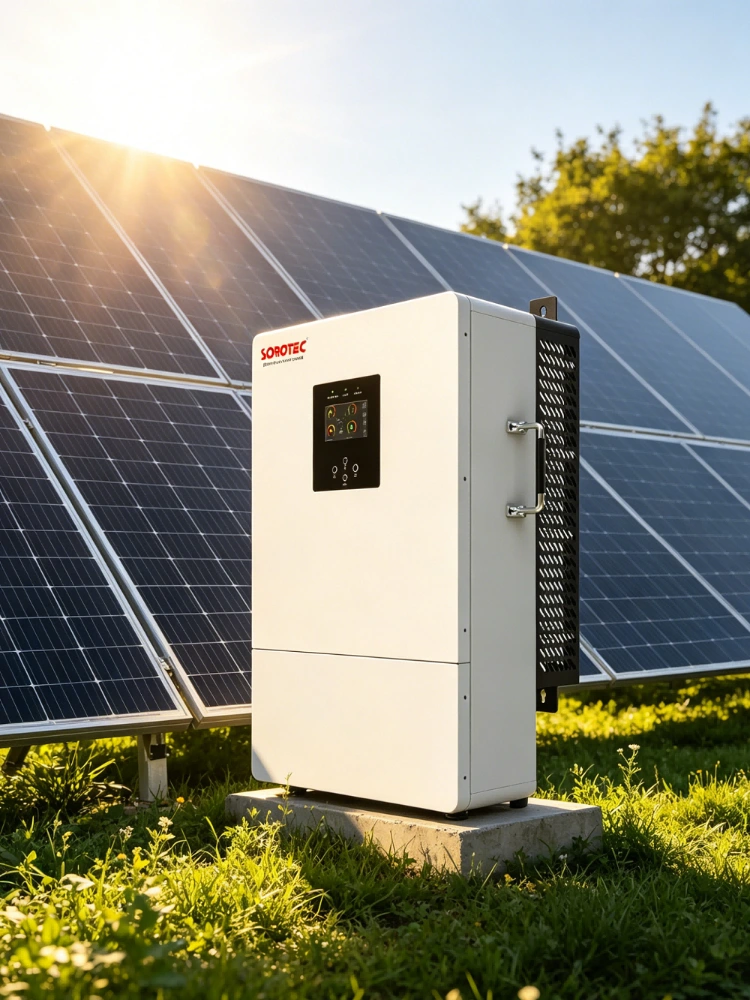
The REVO HMT IP54 L2P G2 split-phase hybrid inverter is one relevant platform for this type of system. SOROTEC lists 8 kW, 10 kW, and 12 kW models with 120/240 Vac split-phase output. Published family features include an IP54 enclosure, two independent MPPT controllers, solar charging current up to 200 A, intelligent load management, and configurable TOU scheduling.
Those details help with shortlisting, but they are not a finished design. Confirm the documents for the exact model, battery, firmware, regional version, and accessories being supplied. In particular, check how that configuration handles schedule periods, minimum SOC, grid charging, current limits, export control, and restart after an interruption.
Commission the Schedule at Its Boundaries
A unit that powers up normally can still behave incorrectly when the clock changes operating modes. Test each boundary instead of waiting for the customer to discover it on the next bill.
Let off-peak charging begin under a normal night load. Record grid and battery power, SOC, temperature, and current on both legs. Confirm the change at the programmed boundary. During peak discharge, start a representative 240 V appliance and observe both legs.
The reserve boundary needs its own test. Near the selected minimum SOC, simulate a grid interruption using the approved commissioning procedure. Confirm that the agreed essential circuits remain supported and that flexible loads are shed as intended. After grid power returns, check that the system does not enter an unexpected forced-charge or export condition.
Save the final settings and readings in the handover record. The SOROTEC website provides product and support access; the project file preserves the site’s acceptance results.
Keep the First Schedule Boring
An elaborate TOU plan is not automatically a good one. If the peak/off-peak price difference is small, the load varies wildly from day to day, or backup reliability is the overriding goal, frequent charge and discharge periods may add little value. Utility rules may also prohibit or limit grid charging.
Start with one charge window, one discharge window, and a conservative reserve. Compare the expected peak reduction with the next bill’s interval data. If the battery reaches its floor too soon, look for a missed 240 V cycle, underestimated load, reduced battery availability, or an overly low charge target. Change one item, then observe the result. Seasonal settings and load-control rules can be added later if the measurements justify them.
FAQ
Can one TOU schedule control both 120 V legs of a split phase inverter?
The inverter may follow one time schedule, but L1 and L2 still need separate current checks. A common timer does not remove per-leg limits, and it does not correct an unbalanced panel.
Should the battery reach its minimum SOC every evening?
Usually not when the same battery provides outage backup. The discharge floor should retain enough usable energy for the essential circuits, required backup duration, conversion losses, and an agreed margin.
Can a 240 V EV charger run during peak-price hours?
It may be technically possible, but an EV charger can consume a large share of inverter output and stored energy. Scheduling it for an off-peak or solar-rich period is often easier. The final decision depends on the approved design and available service capacity.
How often should the TOU settings be reviewed?
Review them when the utility changes its tariff, the customer adds a major appliance, the battery configuration changes, or seasonal conditions materially affect charging and backup needs. The interval data after the first full billing cycle is also worth checking.
Conclusion
Time-of-use control works best when it is treated as a load-management plan, not a timer. Read the tariff, map L1, L2, and the 240 V loads, protect a realistic battery reserve, and test every operating boundary under load. Then use the next set of interval data to see whether the schedule saved money without borrowing too much from the site’s backup plan.