

When the lights suddenly dim or the grid experiences a failure, the primary concern for most individuals turns to the duration of power availability. For owners of homes and businesses relying on SOROTEC systems, determining that timeframe involves more than basic calculations; it delivers a feeling of assurance. Precisely knowing the amount of stored energy enables you to oversee your daily activities or commercial functions without the stress of an unexpected full outage. This guide examines the core components of battery backup, and it assists in optimizing your energy storage configuration.
Why Is Understanding Backup Time Crucial for Your Solar System?
Dependability serves as the core support for every solar initiative. Without awareness of your backup period, you operate without proper direction. Grasping these values aids in establishing practical outlooks for the capabilities of your system when separated from the central utility feed.
Ensuring Reliable Power During Grid Outages
Possessing a backup arrangement proves valuable, but recognizing whether it sustains your refrigerator for 10 hours rather than only 2 hours creates a substantial impact. For those utilizing SOROTEC, such evaluation confirms that essential loads—like medical apparatus, security cameras, or office servers—continue functioning at critical moments. Consequently, it transitions from mere reliance on hope for sustained power to certainty that it remains active.
Optimizing Battery Life and System Efficiency
Batteries carry a notable expense, and proper care preserves significant costs over extended periods. Should you habitually deplete your batteries completely due to inaccurate backup time assessments, you will encounter the need for earlier replacements than anticipated. Accurate computations maintain appropriate discharge thresholds, particularly vital for standard lead-acid configurations sensitive to profound cycling.
Enhancing Economic Returns Through Smart Management
Across numerous areas, electricity rates vary markedly over daily cycles. With knowledge of your backup volume, you can implement “peak shaving”—employing reserved battery energy during peak grid pricing while recharging amid lower tariffs. As a result, this elevates your SOROTEC inverter from a mere emergency aid to an astute economic resource that diminishes your routine utility payments.
How Do You Determine Your Total Electrical Load?
Prior to evaluating the batteries, assess the devices connected to the outlets. Your “load” essentially denotes the collective power consumption from active equipment. Achieving precision here avoids frequent errors, as many underestimate the true draw from their devices.
Identifying and Summing Device Wattage
Commence by listing all items intended for operation during power interruptions. Inspect the labels on the rear of your TV, computer, or microwave for the “W” (Watts) indication. In cases where only Volts and Amps appear, multiply these to derive the Watts. Summing them provides your foundational load, serving as the base for backup time computations.
Factoring in Surge Power for Inductive Loads
Equipment featuring motors—such as air conditioners, refrigerators, or water pumps—presents challenges. These require a considerable initial power surge for activation, frequently amounting to three to five times their regular operating wattage. For instance, if your aggregate running load reaches 2000W yet your fridge initiates with a 3000W surge, a compact inverter could falter. Thus, incorporating these surges prevents system shutdowns precisely when the compressor activates.
Applying a Safety Margin for Future Expansion
Operating your system at maximum capacity continuously remains unwise. This practice mirrors driving a vehicle with the gauge in the danger area. Incorporating a 20% “buffer” into your load assessment shields the inverter from thermal overload and allows space for additional devices in the coming year without necessitating a complete solar array overhaul.
What Role Do Battery Specifications Play in Calculations?
The battery functions as the container for your “fuel.” Analogous to how an expanded gas tank permits longer vehicle travel, an enlarged battery array prolongs illumination during outages. Nevertheless, batteries differ in construction, and label specifications often overlook practical operational realities.
Assessing Ampere-Hour Capacity and Voltage
Batteries typically receive ratings in Ampere-Hours (Ah). To ascertain total energy, multiply Ah by Voltage (V) to obtain Watt-Hours (Wh). As an example, a 100Ah 12V battery stores 1200Wh. Within a 48V system, prevalent in SOROTEC’s robust inverters, you gain considerably more capacity for substantial appliances.
Evaluating Depth of Discharge and Efficiency
The following outlines a comparison of battery type performance under load. Generally, full energy utilization risks damage to the battery.
| Battery Type | Recommended DoD | Average Efficiency | Typical Lifespan |
|---|---|---|---|
| Lead-Acid (AGM/Gel) | 50% | 75% – 85% | 3 – 5 Years |
| Lithium (LiFePO4) | 80% – 90% | 95% – 98% | 10+ Years |
As indicated, Lithium batteries (incorporated in SOROTEC’s All-in-One systems) enable utilization of nearly the entire purchased power, in contrast to Lead-Acid, which limits you to partial discharge.
Considering Cycle Life and Temperature Impacts
Batteries share similarities with humans in disfavoring excessive heat or chill. Should your battery enclosure reach 40°C (104°F) in summer, internal reactions accelerate, hastening wear. Likewise, severe cold temporarily diminishes backup duration, as ions navigate the electrolyte with greater difficulty.
Which SOROTEC Products Best Meet Your Backup Needs?
SOROTEC has invested years in perfecting hardware for off-grid and hybrid applications. Regardless of whether you require straightforward residential support or extensive industrial arrangements, dedicated equipment exists to simplify calculations and deliver consistent results.
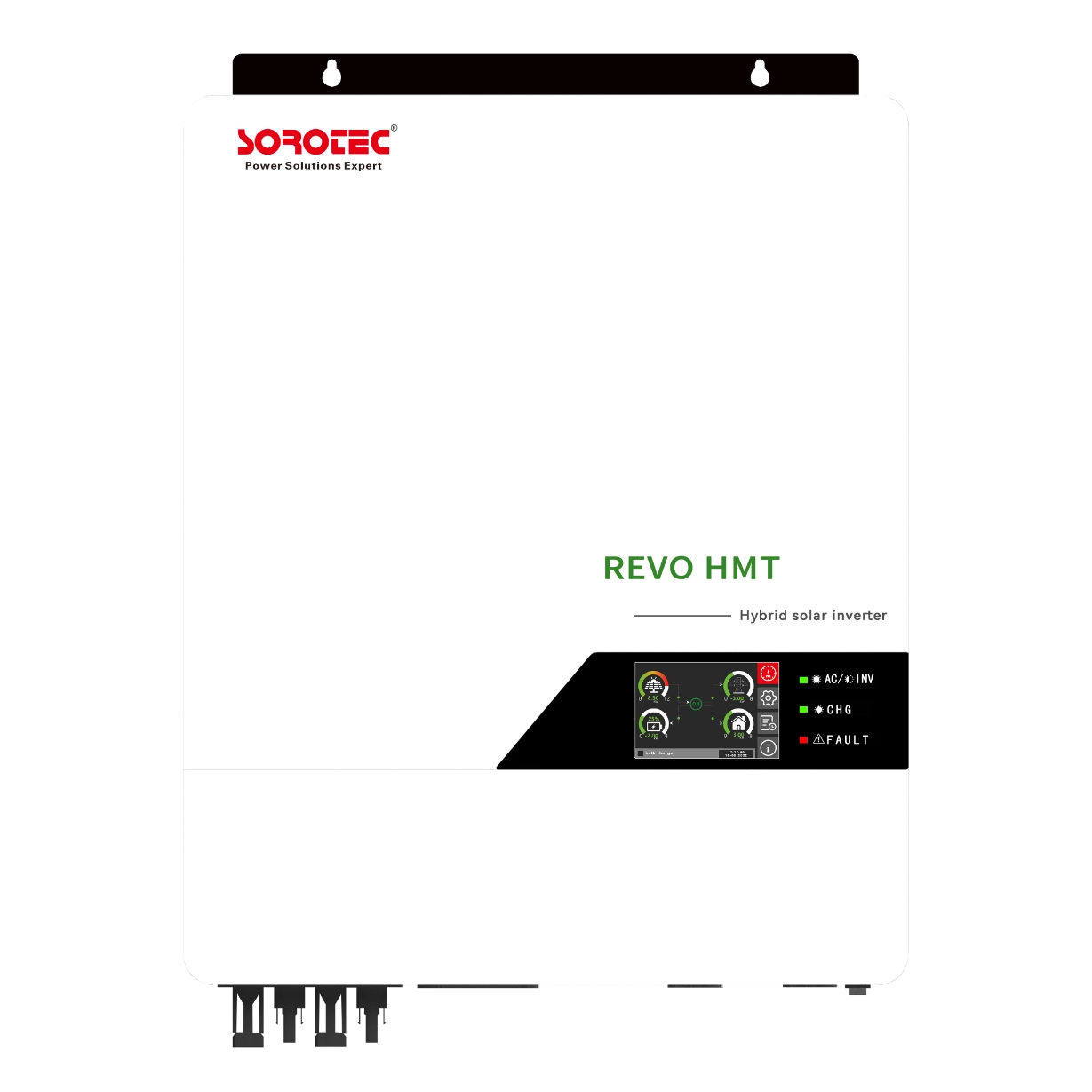
REVO VM V Hybrid On & Off Grid Inverter
This unit acts as a dependable mainstay for those initiating modestly while preserving expansion possibilities. It operates with or absent a battery, an advantageous trait for phased system development. Furthermore, it manages diverse solar inputs, facilitating maximum daytime solar capture into batteries for prolonged nighttime operation.
On & Off Grid REVO HMT-G2 6KW
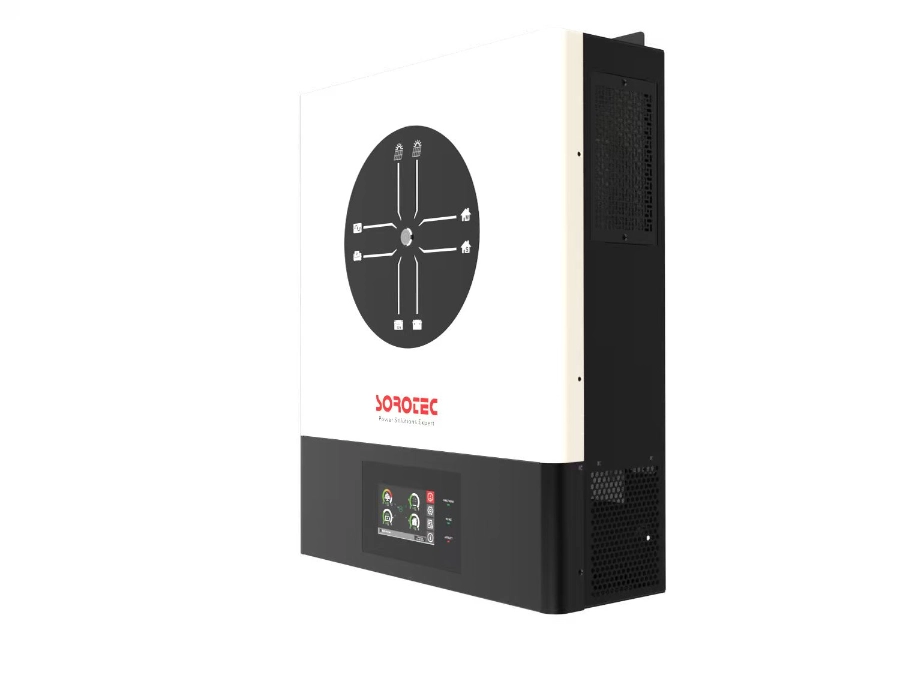
The HMT-G2 targets contemporary intelligent households. It incorporates dual outputs, revolutionizing backup evaluations. You may allocate necessities (lights, internet) to one pathway and conveniences (dishwasher) to another. Upon battery depletion, the inverter selectively terminates non-vital supplies to extend residual duration maximally.
All in One REVO HESS 6/8KW
To bypass intricate wiring and detailed computations, this option stands out. It integrates the inverter and lithium battery within a compact enclosure. With pre-coordinated elements, efficiency reductions prove minimal. Moreover, it displays precise remaining power hours on the interface, removing estimation uncertainties.
How Can You Maximize Your System’s Performance?
Even superior components require occasional assistance to maintain peak functionality. Select prudent practices and configurations can extend equipment longevity by years and augment daily backup intervals. Fundamentally, it concerns more effective utilization of harvested energy.
Implementing Advanced EMS and BMS Monitoring
Contemporary SOROTEC systems include integrated intelligence monitoring each cell in the battery array. The Battery Management System (BMS) verifies equitable workload distribution among cells. Through sustained equilibrium, it averts suboptimal elements from impairing overall efficacy, guaranteeing access to all feasible watt-hours.
Maintaining Optimal Environmental Conditions
Placing your inverter and batteries in a neat, dust-free, climate-regulated location offers the simplest protection for your assets. Dust accumulation obstructs ventilation fans, compelling the inverter to restrict output for cooling. Basic cleaning and ventilation assurance can enhance energy conversion proficiency.
Performing Regular Professional Maintenance
Periodically, professional inspection of connections yields benefits. Gradually, oscillations or thermal variations loosen fasteners, fostering resistance that converts energy to heat wastefully. Securing system conduits firmly and cleanly ensures minimal impedance in power transit from panels via batteries to end-use devices.
| Feature | REVO VM V | REVO HMT-G2 | REVO HESS (All-in-One) |
| Best For | Budget-friendly DIY | High-load Smart Homes | Premium, Easy Install |
| Max PV Input | 8000W – 13000W | 5000W-13000W | 6000W-8000W |
| Parallel Ability | 6 units connected in parallel | Up to 6 units | Modular Expansion |
| Battery Type | Lead-Acid/Lithium | Lead-Acid/Lithium | Integrated Lithium |
FAQ
Q1: How do I quickly estimate my backup time without a complex formula?
A: A straightforward guideline for a 48V 100Ah battery bank (approximately 4.8kWh) indicates it supports a steady 500W load (such as several lights, a laptop, and a fridge) for roughly 7 to 8 hours, given Lithium batteries with elevated depth of discharge. Invariably, incorporate a safety reserve.
Q2: Does the age of my battery affect the calculation?
A: Indeed, it does. With advancing age, batteries exhibit reduced capacity. A battery labeled “100Ah” after three years may perform akin to 80Ah. For legacy systems, wisely diminish projected durations by 10-15% annually to preserve realism.
Q3: Can I mix different battery brands or sizes in one SOROTEC system?
A: Mixing brands or sizes is highly inadvisable. Distinct batteries possess varying internal resistances and charging velocities. Upon integration, the newer or more potent unit assumes disproportionate effort and deteriorates ahead of schedule, whereas the elder may fail to achieve complete charge, markedly distorting backup projections.