

Stable electricity has quietly become the backbone of almost every modern operation—from factories and hospitals to data centers and telecom sites. Even a tiny voltage drop or distortion can interrupt sensitive devices. And in many regions, power grids are aging or overloaded, making high-quality backup and conditioning equipment more important than ever.
SOROTEC, a power-electronics manufacturer with nearly two decades of experience, builds UPS and energy systems used across finance, transport, medical facilities, industrial automation, and ICT infrastructure. Among its solutions, the DSP sine wave UPS stands out for delivering clean, consistent, and predictable power in situations where fluctuations can cost a business real money.
Why Does Power Stability Matter for Modern Industrial and Commercial Systems?
Before looking at how a DSP sine wave UPS works, it helps to understand why a steady electrical supply is such a big deal today. Devices used in factories, IT rooms, and communication networks have become more delicate. Their power thresholds are much tighter than many people think, and grid fluctuations can affect them in different ways.
Sensitive Equipment Protection
Machines running on microprocessors respond poorly to noisy or clipped waveforms. A sudden voltage sag as small as 10–15% can cause automation systems to freeze or reset. Medical imaging devices, server racks, and CNC lines often rely on a perfectly smooth voltage curve.
A DSP-controlled UPS outputs a pure sine wave—very close to what equipment designers expect—so electronics continue to function normally rather than being forced into emergency shutdowns.
Reduced Downtime and Operational Losses
Power interruptions don’t need to last long to be expensive. According to EIA data, U.S. industrial users face an average of 112 minutes of outage time per year, yet the financial impact is far from small. Short “blinks” cause almost the same level of disruption as full outages.
| Event Type | Grid Disturbance Duration | Typical Result in Industrial Sites |
|---|---|---|
| Voltage drop | 0.1–3 seconds | Motor stoppage, PLC error, robotic arm reset |
| Momentary outage | < 5 seconds | Production line restart, batch loss |
| Full outage | > 5 seconds | Downtime, spoilage, safety shutdown |
A stable UPS, especially one with digital signal processing, reacts instantly and fills the gap so these losses never occur.
Extended Service Life of Electrical Systems
Poor-quality voltage ages equipment faster. Heat buildup, repeated restarts, and harmonics all contribute to shorter lifespans. Clean sine-wave power helps motors run cooler, reduces transformer noise, and keeps electronic components from over-stressing.
Over time, this translates into lower maintenance budgets—and fewer surprises.
How Does a DSP Sine Wave UPS Improve Output Quality?
With the problem defined, the next question is: what does DSP actually change inside a UPS? Quite a lot. The technology gives the UPS a fast “brain” capable of analyzing and adjusting the waveform in real time.
Pure Sine Wave Output for Clean Power Delivery
A pure sine waveform closely matches the pattern from a healthy utility grid. DSP actively shapes the inverter output so the curve stays smooth and predictable, even when the load changes suddenly.
This is not only important for IT loads. Industrial motors, pumps, and HVAC units also draw current differently depending on speed and torque. A DSP UPS keeps the sine wave intact, preventing the kind of distortion that can cause vibration or overheating.
Rapid DSP-Based Monitoring and Corrections
The internal processor measures voltage, current, frequency, and waveform distortion thousands of times per second. When it notices a deviation, it adjusts the signal right away.
Traditional UPS units using analog control respond slower, sometimes introducing more distortion while correcting it. DSP systems do the job much faster and with more accuracy, which is why they are now the standard for high-grade power-conditioning equipment.
Lower Harmonic Distortion for Sensitive Loads
Harmonic distortion is an issue many users never think about, but it affects everything from power losses to overheating. IT equipment usually requires THD below 3–5%.
DSP UPS systems typically keep THD under 2–3%, which is much cleaner than older models.
| Parameter | Standard Grid | Old-Generation UPS | DSP Sine Wave UPS |
|---|---|---|---|
| THD (Total Harmonic Distortion) | 3–5% | 5–10% | ~2% |
| Output waveform | Sinusoidal | Modified / stepped | Pure sine |
| Response speed | Normal | Slower analog | Very fast digital |
What Makes SOROTEC’s DSP UPS Architecture More Reliable?
SOROTEC has been working in power electronics since 2006, supplying UPS, air-conditioning solutions, energy storage systems, and PV inverters to critical industries worldwide. Its DSP UPS design reflects years of engineering updates and field experience.
Advanced Power Electronics and Intelligent Control
SOROTEC uses full-bridge inverter structures, high-frequency switching, and multiple protection layers. The DSP platform coordinates all of these parts so the UPS stays stable even under complicated load conditions.
High-Efficiency Conversion and Stable Power Regulation
Clean conversion means less heat, quieter operation, and better long-term durability. SOROTEC UPS units follow international standards for EMC, grid compliance, and safety—important for hospitals, government systems, and telecom sites.
Strong Compatibility With Industrial and ICT Equipment
The UPS design supports a wide range of load types: servers, medical imaging systems, motor drives, production-line controls, ATM networks, base stations, and more.
This versatility is one reason SOROTEC products are used in more than 30 global markets.
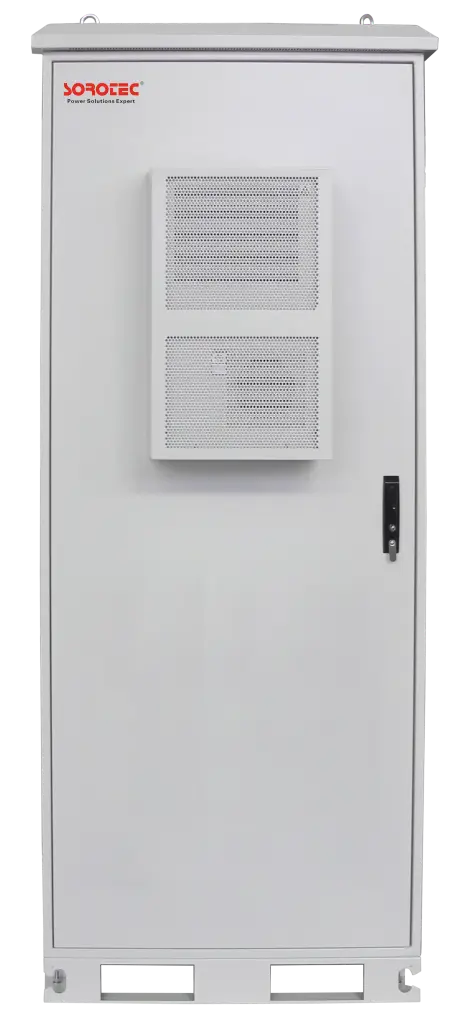
How Does the MPGS Series 50–600kW Contribute to Power Stability in On-Grid Applications?
Even though the MPGS Series is primarily an on-grid solar inverter, it plays a large part in overall power quality within solar-powered factories, commercial buildings, and industrial parks. A building with unstable solar generation can suffer the same problems as one with unstable grid electricity.
High-Precision Grid Synchronization
The MPGS inverter keeps its output fully coordinated with the grid, preventing voltage swings, reverse current, and flicker. This helps businesses integrate large PV systems without creating power issues for their own loads.
Low THD and Efficient Energy Conversion
The MPGS Series maintains low harmonic distortion and converts solar energy at high efficiency, which smooths the power delivered to the site.
According to IEA solar reports, modern commercial inverters average 97–98% efficiency, and SOROTEC solutions fall within this range.
Modular Design for Large-Scale System Stability
For industrial parks and commercial buildings that run multiple inverters in parallel, stability comes from modularity.
The MPGS platform supports large capacity expansion from 50 kW up to 600 kW, making it suitable for large solar farms and distributed commercial systems.
Where Can a DSP Sine Wave UPS Deliver the Most Value?
Different industries experience grid instability in different ways. This makes a high-quality UPS not just a backup device, but a day-to-day stabilizer.
Data Centers and Communication Base Stations
Telecom networks and cloud facilities demand uninterrupted power. Even a two-second drop can disconnect thousands of users. DSP UPS units provide predictable runtime and smooth switchover, preventing service interruptions.
Industrial Automation and Manufacturing Lines
Robotic arms, conveyors, and PLC-driven lines rely on consistent voltage. Power dips can ruin an entire production batch. A DSP UPS keeps these loads running smoothly while reducing stress on motors.
Medical, Finance, and Government Facilities
Hospitals require steady voltage for imaging devices, labs, and emergency rooms. Financial institutions need stable power for ATMs and trading systems. Government centers rely on secure servers and surveillance systems.
In these sectors, low-quality power is more than an inconvenience—it becomes a risk.
FAQs
Q1: Is a DSP UPS worth it if the local grid is usually stable?
A: Yes. Modern equipment is more sensitive than before. Even small distortions or switching spikes can interrupt IT equipment or automation systems. A DSP UPS acts like a daily stabilizer, not just a backup battery.
Q2: Can a DSP sine wave UPS work with solar or energy-storage systems?
A: SOROTEC UPS units can be deployed together with PV inverters and battery systems, and many customers use them in hybrid or commercial solar setups. They complement each other—UPS handles real-time stability, while PV systems reduce grid dependence.
Q3: Does pure sine wave output really matter?
A: It does. Motors run cooler, servers restart less, and sensitive electronics behave more predictably. Modified or stepped wave output may appear fine at first, but over time it stresses equipment and reduces lifespan.


