

With solar projects expanding worldwide, engineers focus closely on the way panel designs shape everyday power results. As a leading manufacturer with over 18 years of expertise in power electronics, SOROTEC has been at the forefront of this evolution, providing advanced energy storage and inverter solutions across 60+ countries. Bifacial and monofacial solar panels rank among the top choices in current talks. Although people use both types broadly, their results change notably according to location features, arrangement methods, and inverter pairings.
Power delivery now involves far more than simple panel ratings, since it relies on the effective way sunlight gets gathered, transformed into electricity, and controlled throughout the whole PV array. Here, selecting suitable panels and inverters proves essential, particularly for combined setups that include storage options.
What Are The Key Differences Between Bifacial And Monofacial Solar Panels?
Examining production figures makes sense only after grasping the basic operations of these panel varieties and the sources of their primary contrasts.
Technical Characteristics Of Bifacial Panels
Builders craft bifacial solar panels to produce electricity from the front as well as the back of each unit, so that in addition to straight rays striking the front face, the back surface gathers bounced rays from the earth, adjacent buildings, or roof layers. People refer to this bounced illumination as albedo, whose intensity hinges largely on the shade and setup of those areas.
During practical deployments, installers place bifacial panels on lifted supports or following mechanisms, thereby permitting greater access to light on the back, and for that reason, these systems operate optimally in vast areas featuring reflective earth covers like cement paths, pale pebbles, beach areas, or winter landscapes blanketed in snow.
Findings from sector tests by NREL and IEA PVPS reveal that bifacial panels yield 5% to 30% more energy yield relative to monofacial units, varying with the specifics of placement.
Technical Characteristics Of Monofacial Panels
Monofacial panels continue as the standard PV method across the globe, as these units absorb rays exclusively from the front and generally attach directly to roof planes or near soil levels, while their structure remains basic, mounting proves adaptable, and total expenses stay modest.
Whenever bounced rays prove scarce, as on shadowy roofs or dense groupings, monofacial panels supply consistent and foreseeable results, which in turn positions them as a preferred option for household roofs and minor business ventures.
Although monofacial panels miss out on back-surface advantages, their output relative to spending remains viable in various sectors.
Impact On Charge Output And Energy Yield
The variation in power generation between bifacial and monofacial arrangements goes beyond concepts, since it emerges evidently in prolonged operational logs.
The following table outlines standard production gaps noted in power plant and business initiatives.
| Panel Type | Typical Annual Energy Gain | Key Conditions |
| Monofacial | Baseline (0%) | Rooftops, low albedo surfaces |
| Bifacial | +5% to +15% | Standard ground mount |
| Bifacial | +20% to +30% | High albedo, trackers, snow |
These improvements lead straight to enhanced battery filling rates and better inverter efficiency, particularly in combined arrays where storage holds a key position.
How Do Environmental Conditions Affect Bifacial Vs Monofacial Performance?
Merely the panel method fails to fix output levels, because outside elements can either reveal or curb the strengths of bifacial setups.
Effect Of Ground Albedo And Reflected Irradiance
Earth reflection counts as a major element for bifacial panels, and per NREL data, common albedo figures differ sharply across ground varieties.
| Surface Type | Average Albedo |
|---|---|
| Asphalt | 0.05 – 0.10 |
| Grass | 0.20 – 0.25 |
| Concrete | 0.30 – 0.40 |
| White gravel | 0.40 – 0.50 |
| Fresh snow | 0.60 – 0.90 |
Elevated albedo raises back-surface light levels promptly, thereby enhancing the general unit production, whereas monofacial panels scarcely respond to earth types, which accounts for their even operation in diverse surroundings.
Performance In High Latitude And Cloudy Conditions
Bifacial panels handle northern zones effectively, where scattered rays and bounces carry greater weight, and snow layers boost back-surface input notably in cold periods, thus helping to counter reduced light times.
Monofacial panels function steadily amid overcast skies as well, yet they forgo the additional lift from bounced rays, thereby restricting their yearly adaptability.
Temperature And Shading Sensitivity Differences
Each panel category faces output drops in warm settings, but bifacial placements typically enjoy superior air flow from their raised positions, so they manage warmth accumulation better.
Shadows produce intricate outcomes, for partial covers on bifacial back surfaces impact less than those on fronts, although irregular shadow forms require thorough evaluation in planning stages.
Why SOROTEC Hybrid Inverters Matter For Maximizing PV Output?
Selecting panels by itself fails to set array results, since inverter actions shape directly the portion of produced power that converts, saves, and applies effectively.
Single-Phase IP66 REVO HES Hybrid Energy Storage Inverter Role In PV Systems
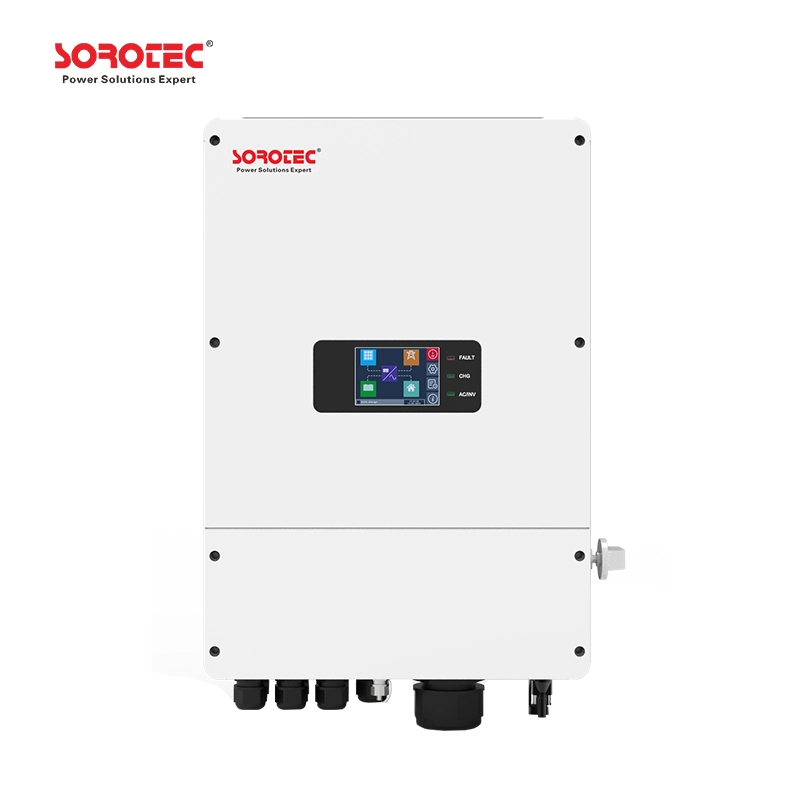
The Single-Phase IP66 REVO HES Hybrid Energy Storage Inverter (6/8/10kW) suits challenging outside conditions and robust PV arrays, as its IP66 shield enables reliable function in dusty, moist, or shore locations where bifacial deployments frequently occur.
Equipped with extensive MPPT voltage bands and reliable battery pairing, this inverter accommodates greater and fluctuating feeds from bifacial collections, leading to even filling patterns and superior energy gathering in dawn or dusk periods when back-surface effects dominate.
Single-Phase IP54 REVO HMT G2-IP54 Hybrid Inverter Benefits For Solar Panels
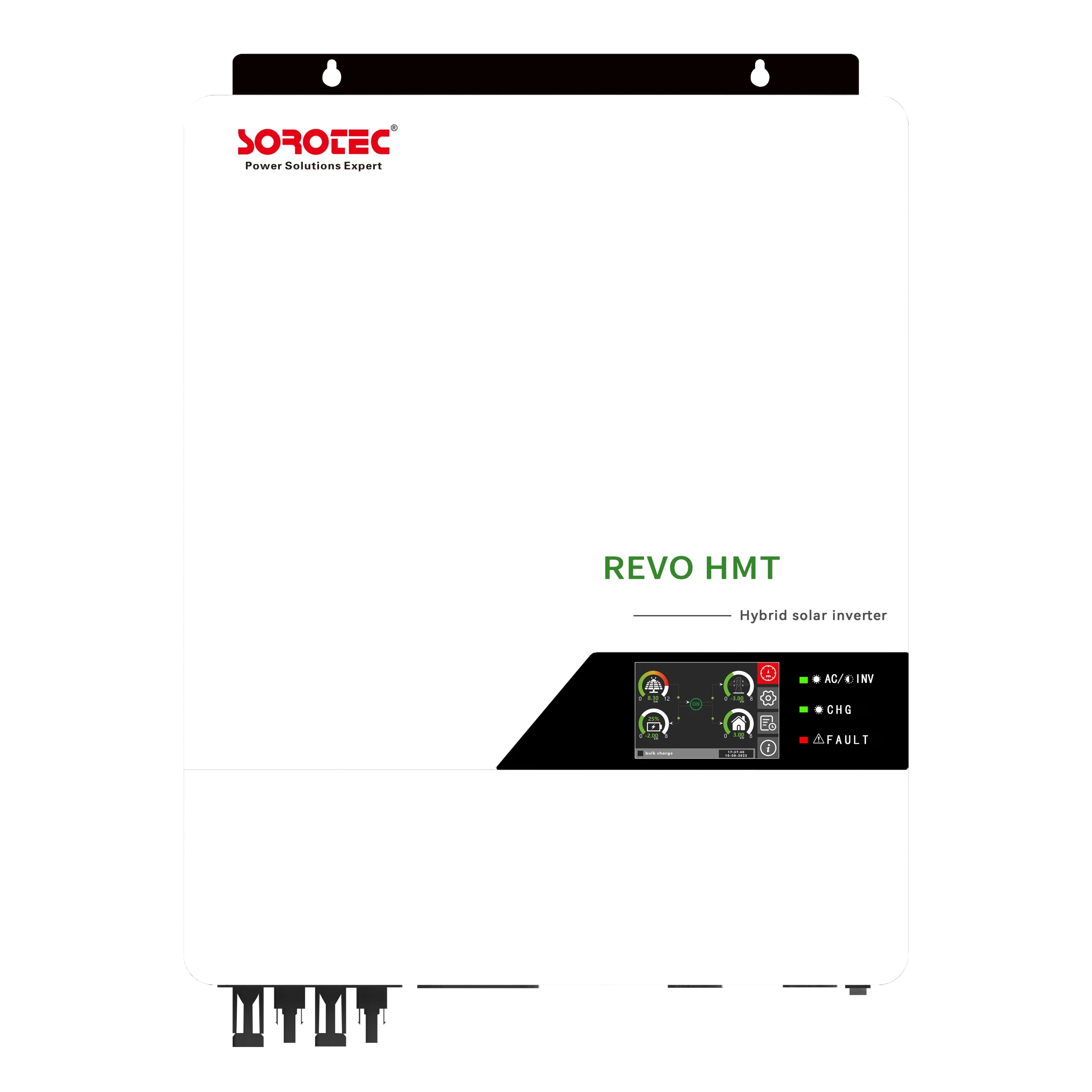
The REVO HMT G2-IP54 Hybrid Energy Storage Inverter (4–11kW) provides versatile aid for home and small-scale business arrays, and it connects smoothly with monofacial roof groups alongside compact bifacial earth-based ones.
Through its combined framework, surplus PV power stores without loss instead of trimming or discarding, which holds special worth for bifacial arrays whose top production windows might surpass standard noon spans.
On & Off Grid REVO HMT-G2 6KW Integration With Bifacial And Monofacial Arrays
The REVO HMT-G2 6KW On & Off Grid Inverter aids initiatives facing grid unreliability or absence, and in isolated or blended small-grid configurations, steady power filling outweighs maximum values.
Through overseeing shifting PV supplies and aligning battery releases, this inverter assists bifacial and monofacial arrays in sustaining firm energy provision amid varying climate and usage scenarios.
When Should You Choose Bifacial Over Monofacial Panels?
Opting for bifacial versus monofacial methods rests on initiative aims, area availability, and financial limits.
Site Conditions Favoring Bifacial Panels
Bifacial panels deliver peak results in expansive placements featuring strong bounce rates and adequate gaps underneath, so large energy facilities, vehicle shades, farm-based PV, and earth-fixed units with fair-toned covers represent prime applications.
Cost-Benefit Comparison For Long-Term Yield
Bifacial units demand higher initial outlays, but their extended lifespan production frequently reduces the average electricity price, especially alongside combined inverters capable of saving and employing the surplus power without waste.
Compatibility With SOROTEC Energy Storage Inverters
SOROTEC hybrid inverters manage varying PV feeds while preserving array balance, which positions them ideally for bifacial ventures where production fluctuates across daily cycles and yearly shifts.
What Are The ROI And Charge Maximization Strategies For PV Projects?
Achieving top power filling calls for integrated array planning over standalone part selections.
System Design Best Practices For Bifacial Panels
Suitable angles, intervals between lines, and earth handling can markedly raise back-surface benefits, and even basic actions like applying fair-toned pebbles elevate yearly production with minimal added costs.
Optimizing Monofacial Systems With SOROTEC Inverters
Within monofacial deployments, inverter choices influence usable power gains most, as effective MPPT monitoring, swift battery actions, and adaptable usage oversight draw greater returns from each placed kilowatt.
Monitoring, Storage And Charge Output Optimization Metrics
Combined arrays fitted with storage profit from steady oversight and intelligent filling regulation, thereby lessening cutbacks and enhancing in-house usage, which lifts complete array payoffs irrespective of panel category.
FAQ
Q1: Do bifacial solar panels always produce more energy than monofacial panels?
A: Not always. Bifacial panels outperform monofacial panels mainly in environments with good rear-side light reflection and proper installation height. In low-albedo or shaded locations, the difference may be small.
Q2: Are SOROTEC hybrid inverters compatible with both panel types?
A: Yes. SOROTEC hybrid inverters are designed to work with both bifacial and monofacial PV arrays, supporting wide voltage ranges and stable battery integration.
Q3: Is bifacial technology suitable for residential projects?
A: Bifacial panels can work in residential settings, but benefits depend on roof design and reflectivity. In many cases, high-efficiency monofacial panels combined with hybrid inverters remain the more practical option.