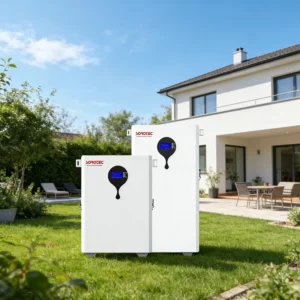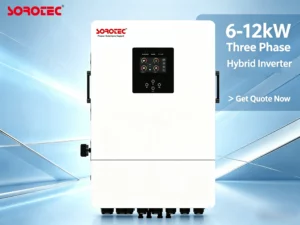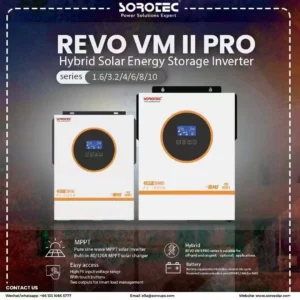

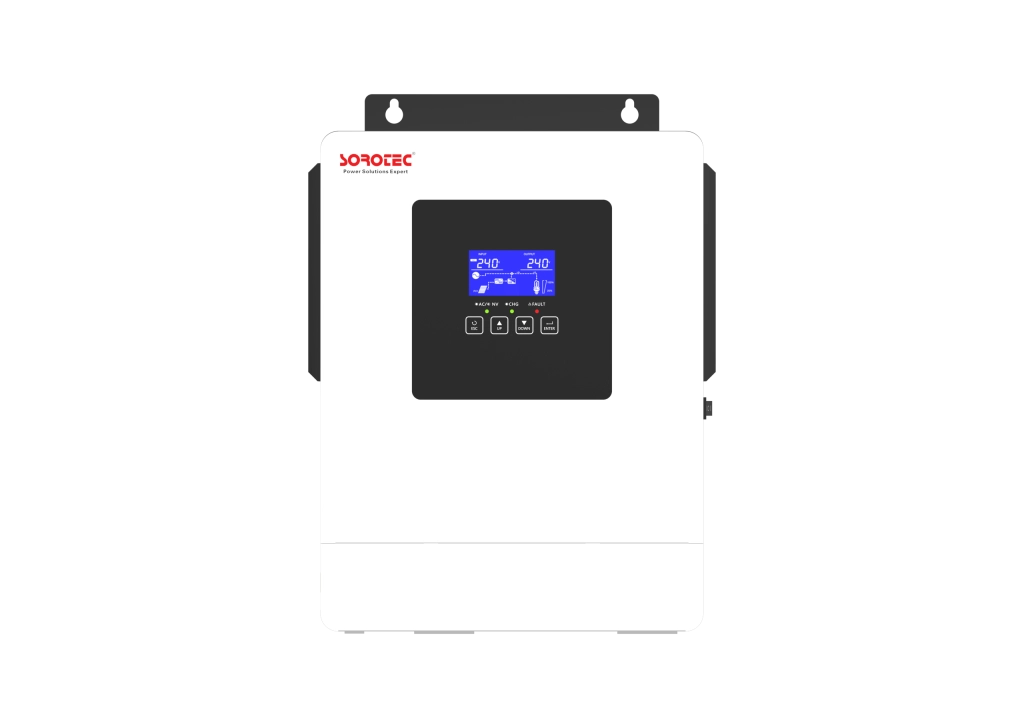
A hybrid solar inverter can run without a battery when its design supports direct solar-to-load operation. If you are asking, “What Size Solar Inverter Do I Need,” begin with the appliances that must run together, not every watt listed in the building. You must also check starting loads, PV string voltage, grid rules, and what should happen when sunlight drops.
SOROTEC has worked in power electronics and new energy since 2006. Its 20,000-square-meter production base, 350 employees, testing facilities, certifications, and OEM/ODM service suit installers, distributors, and project buyers. Its broad power product range also supports projects that may add storage later.
How Does a Hybrid Solar Inverter Work Without a Battery?
Without a battery, the inverter has no energy reservoir. It must balance power as sunlight, load demand, and grid conditions change.
Direct Solar-to-Load Conversion
Solar modules produce DC electricity. The inverter tracks the array’s operating point, converts DC into AC, and supplies active loads. If the array produces 4 kW while your loads use 3 kW, the remaining power follows the configured export or limiting rule.
Grid-Assisted Load Support
When solar production falls below demand, the grid can supply the shortfall. A passing cloud can cut PV output quickly. Without grid support or stored energy, the system must reduce load or stop.
Battery-Free Power Flow
| Operating Condition | Battery-Free System | System with a Battery |
|---|---|---|
| Strong sunlight | PV powers loads directly | PV powers loads and may charge storage |
| Weak sunlight | Grid or load reduction covers the gap | Battery may cover the gap |
| Night | Grid or another source is required | Stored energy can supply selected loads |
| Grid outage | Output depends on PV and inverter design | Backup continues within system limits |
| Excess solar | Exported, limited, or unused | May be stored before export |
Removing the battery lowers initial cost, but it also removes the buffer that smooths daily power changes.
What Can a Batteryless Solar System Do Well?
A battery-free design works best when daytime demand follows solar production and the grid is stable.
Daytime Self-Consumption
Offices, workshops, pumps, shops, and homes with daytime cooling can use solar as it is produced. Yet a daytime array offers less value when most electricity is used after sunset.
Phased Project Investment
You can install PV and a suitable inverter first, then add storage when the budget, tariff, or outage risk changes. This also gives you real load data before choosing battery capacity.
Practical Project Evidence
Review similar applications before buying. The company’s project case studies cover inverter and telecom power uses, helping you ask better questions about installation, operating modes, and support.
What Are the Main Limits of Running Without a Battery?
Battery-free operation is not round-the-clock independence. Problems begin when available PV power is treated as guaranteed power.
No Nighttime Energy Reserve
Without storage, midday energy cannot be moved into the evening. Night loads must rely on the grid, a generator, or another source.
Variable Output During Poor Weather
Clouds, shade, dirt, temperature, and array orientation change output. A 6 kW array will not deliver 6 kW all day. Obvious, yes, but quotations still miss it.
Limited Outage Performance
Some battery-free inverters can drive loads from PV during an outage, but critical equipment still needs load separation and enough live PV power.
What Size Solar Inverter Do I Need for a Battery-Free System?
Start with the highest simultaneous load, then check surge demand. Motors can draw much more power during startup. The attached guidance recommends allowing for those peaks and adding about 10% to 20% headroom. Excessive oversizing raises cost; undersizing causes trips.
Continuous Load Calculation
Add only loads expected to run together. If lighting draws 500 W, office equipment 1,200 W, cooling 2,000 W, and a pump 1,000 W, the running load is 4.7 kW. A 6 kW inverter may fit, subject to starting current and surge rating.
Starting and Peak Demand
Motor loads may restart together after a transfer, creating a sharp peak. Check the data plate or measured startup current. Load sequencing can be cheaper than a larger inverter.
PV Voltage and Current Matching
Cold-weather open-circuit voltage must stay below the PV maximum, operating voltage must remain inside the MPPT range, and string current must stay within its limit.
Why Is the REVO MPI a Strong Battery-Free Option?
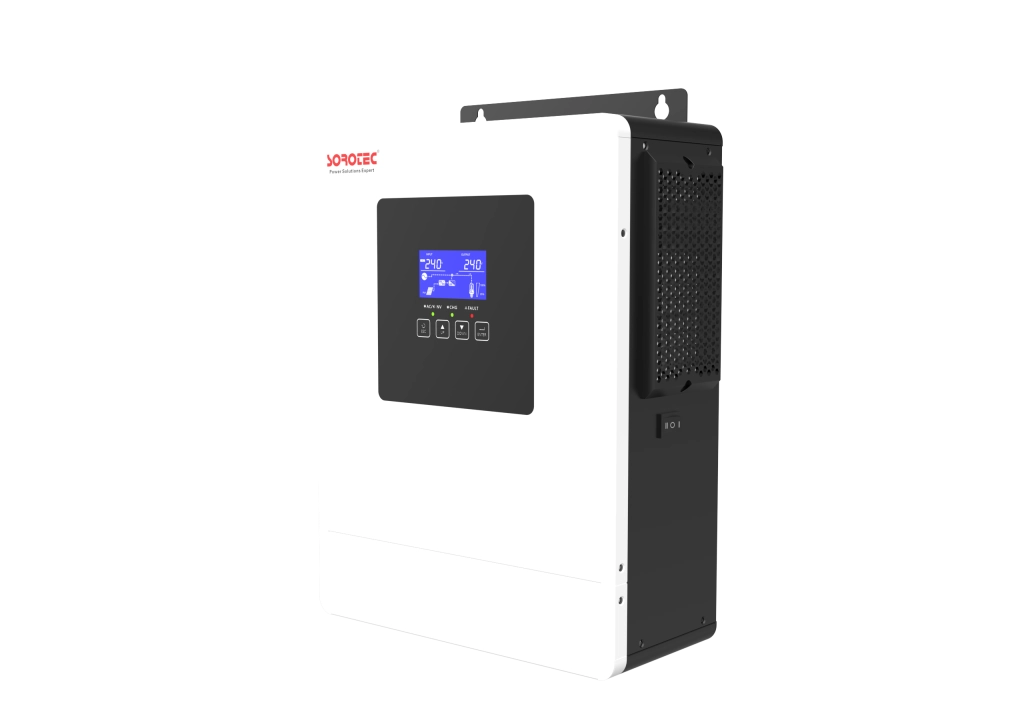
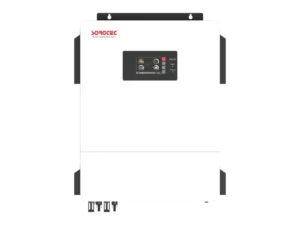
For direct PV use, the REVO MPI Photovoltaic Inverter comes in 6 kW and 10 kW ratings. Its core feature is pure-PV off-grid load supply through grid-disconnected load-drive technology. A built-in CT meter supports load allocation.
Verified Product Data
| Specification | Published Value | Buyer Relevance |
|---|---|---|
| Rated options | 6 kW / 10 kW | Larger homes and light commercial loads |
| Peak efficiency | 97% | Lower conversion loss |
| PV input range | 60–450 VDC | Flexible string planning within limits |
| Switching time | Less than 10 ms | Fast source transfer |
| 10 kW unit weight | 5.69 kg | Easier handling and wall mounting |
| Load management | Built-in CT meter | Power allocation as demand changes |
Check these figures against the final datasheet for your market and product revision. That small step saves a surprising number of site problems.
Suitable Use Cases
The 6 kW option suits moderate demand; the 10 kW option gives more room for larger daytime loads. Shops, offices, workshops, pumps, and homes are natural candidates.
A small workshop, for example, may run lighting, computers, ventilation, and one machine during daylight. In that case, direct PV use can reduce grid consumption without adding battery cost. A site that starts several motors together needs a closer surge check.
Limits to State Clearly
The inverter can support loads from PV when the grid is disconnected, but output still depends on the solar array at that moment. It cannot provide stored nighttime energy without a separate storage path.
This distinction should appear in quotations and project discussions. “Operates without a battery” describes the inverter’s power architecture. It does not mean the system can produce solar power after dark.
How Can SOROTEC Support Your Project?
A useful quotation starts with load data, module specifications, grid voltage, site conditions, and operating mode. Review the manufacturer’s technical and production background before requesting a proposal. Its service covers selection, OEM/ODM discussion, technical communication, order support, and after-sales coordination.
Send your continuous load, startup details, panel Voc, Vmp, Isc and Imp, string layout, local grid requirements, and future storage plan. Then contact the project team for model confirmation and a quotation. The right inverter should fit today’s load without closing the door on tomorrow’s system.
FAQ
Q: Can a hybrid solar inverter run without a battery?
A: Yes, when the model supports battery-free or direct PV operation. Grid power can cover shortfalls in a connected system, while outage output depends on inverter design and available sunlight.
Q: Is a battery-free inverter suitable for motor loads?
A: It can be, but you must check startup current, surge capability, and changing PV output. Pumps and compressors often need far more power at startup than during normal operation.
Q: What Size Solar Inverter Do I Need?
A: Add the loads that run together, include startup demand, then allow sensible headroom. Also verify PV string voltage, input current, grid phase, and outage requirements.